
EASA Approval Adds Skids, SAR Mode for Leonardo AW169 | Aero-News Network
Aero-News Network
RSS icon RSS feed
podcast icon MP3 podcast
Subscribe Aero-News e-mail Newsletter Subscribe

Airborne Unlimited -- Most Recent Daily Episodes

Episode Date

Airborne-Monday

Airborne-Tuesday

Airborne-Wednesday Airborne-Thursday

Airborne-Friday

Airborne On YouTube

Airborne-Unlimited-12.01.25

AirborneNextGen-
12.02.25

Airborne-Unlimited-12.03.25

Airborne-AffordableFlyers-11.20.25

AirborneUnlimited-11.21.25

LIVE MOSAIC Town Hall (Archived): www.airborne-live.net

Sun, Nov 13, 2022

EASA Approval Adds Skids, SAR Mode for Leonardo AW169

New Single-Pilot Search & Rescue Mode Auto-Flies Predetermined Search Pattern

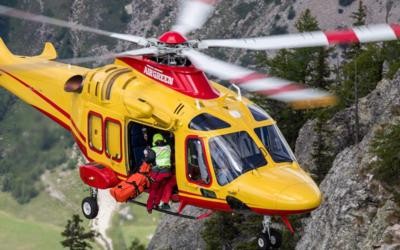
Leonardo's AW169 helicopter’s options list grows with the recent EASA approval of a skid undercarriage, IFR, single pilot,  and advanced search & rescue modes. 

The new skids add another option past the usual retractable or fixed landing gear commonly seen on the type, making the AW169 the only modern CS29-certified aircraft to offer the trifecta. With certification in hand, Leonardo can now begin deliveries of skid-equipped AW169s, with the first unit destined for Italian law enforcement.

While the skids are an attention grabber of sorts, the really big news comes from the new software enhancements from the recent introduction of Phase 8 core avionics software. Advanced Search and Rescue (SAR) Modes introduce dedicated FMS search patterns allowing operators to engage an autopilot mode to fly along a predefined search path, minimizing workload throughout a search mission. That high level of automation allows for single-pilot SAR certification, a first for a civil helo in the EU. 

Additional developments in the works will further bolster AW169 performance, like a 700-880 kg modular fuel tank and a 3-seat/3rd row modification to bring capacity up to 11 passengers. Leonardo reports that the model has found considerable success in the European market in everything from law enforcement and VIP transport to offshore energy support. The twin-engine design has helped it gain a foothold anywhere that added redundancy and reliability is needed. Currently, more than 300 aircraft are on order, with 150 previously delivered across 25 countries. The AW169 has racked up more than 125,000 flight hours throughout its life cycle, with 3,000 flight hours in Swedish EMS operations alone. 

FMI: www.leonardo.com

Advertisement

More News

ANN's Daily Aero-Term (12.01.25): Convective SIGMET

Convective SIGMET A weather advisory concerning convective weather significant to the safety of all aircraft. Convective SIGMETs are issued for tornadoes, lines of thunderstorms, e>[...]

ANN's Daily Aero-Linx (12.01.25)

Aero Linx: United Flying Octogenarians WELCOME to a most extraordinary group of aviators, the United Flying Octogenarians (UFO). Founded in 1982 with just a handful of pilots, we h>[...]

NTSB Final Report: Remos Aircraft GmbH Remos GX

Pilot’s Decision To Attempt Takeoff With Frost Covering The Airplane’s Wings Analysis: The pilot of the light sport airplane was preparing to depart for a cross-country>[...]

Aero-News: Quote of the Day (12.02.25)

“We’ve paid for the cable line’s repair for the customer and have apologized for the inconvenience this caused them...” Source: Some followup info from an A>[...]

ANN's Daily Aero-Term (12.02.25): Coupled Approach

Coupled Approach An instrument approach performed by the aircraft autopilot, and/or visually depicted on the flight director, which is receiving position information and/or steerin>[...]

blog comments powered by Disqus



Advertisement

Advertisement

Podcasts

Advertisement

© 2007 - 2025 Web Development & Design by Pauli Systems, LC

