
FAA Slow To Implement NTSB Recommendations Following 'Miracle On The Hudson | Aero-News Network
Aero-News Network
RSS icon RSS feed
podcast icon MP3 podcast
Subscribe Aero-News e-mail Newsletter Subscribe

Airborne Unlimited -- Most Recent Daily Episodes

Episode Date

Airborne-Monday

Airborne-Tuesday

Airborne-Wednesday Airborne-Thursday

Airborne-Friday

Airborne On YouTube

Airborne-Unlimited-12.01.25

AirborneNextGen-
12.02.25

Airborne-Unlimited-11.19.25

Airborne-AffordableFlyers-11.20.25

AirborneUnlimited-11.21.25

LIVE MOSAIC Town Hall (Archived): www.airborne-live.net

Sat, Sep 17, 2016

FAA Slow To Implement NTSB Recommendations Following 'Miracle On The Hudson

Only Six Have Been Implemented, According To Reports

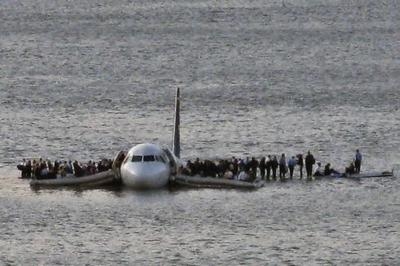
The FAA has been slow to implement the 35 safety recommendations made by the NTSB following the ditching of US Airways Flight 1549 in the Hudson River, the event now famously known as the "Miracle on the Hudson".

The Associated Press reports that, according to its research, 14 of the recommendations were rejected by the agency as being "unacceptable", and one has been withdrawn.

Of those remaining, only six of the recommendations have been implemented, according to the report.

The AP cites as examples a recommendation that all flights be equipped with life rafts, inflatable vests, and floating seat cushions after the flight. They were not required on Flight 1549, but the airplane was so equipped. The FAA said that the decision to equip airliners with floatation devices should be left up to the airlines.

When the Airbus A320 went down after a bird strike flamed out both engines, the life rafts at the rear of the aircraft were submerged and rendered unusable. The NTSB recommended changing the location of the life rafts to make them more accessible, but the FAA said that if Capt. Sullenberger had ditched the airplane at the recommended speed, the underside of the airplane would not have been damaged and the rafts would have been usable. The NTSB, however, that a pilot's ability to maintain those descent speeds has never been tested, and so the procedure is unreliable.

The FAA also rejected an NTSB recommendation to require carriers to create procedures for dealing with a low-altitude dual-engine failure in checklists and pilot training as being unacceptable. The board's investigation revealed that dual-engine-out procedures are intended for use at altitudes above 20,000 feet.

(Image from NTSB accident report)

FMI: http://www.ntsb.gov/investigations/AccidentReports/Reports/AAR1003.pdf

Advertisement

More News

NTSB Prelim: Cirrus Design Corp SR20

The Airplane Made An Uncommanded Right Yaw And Roll, And He Was Unable To Maintain Control Of The Airplane On November 11, 2025, about 1750 central standard time, a Cirrus SR20, N8>[...]

ANN's Daily Aero-Linx (11.30.25)

Aero Linx: Florida Antique Biplane Association "Biplanes.....outrageous fun since 1903." That quote really defines what the Florida Antique Biplane Association (FABA) is all about.>[...]

ANN's Daily Aero-Term (11.30.25): Wind Shear Escape

Wind Shear Escape An unplanned abortive maneuver initiated by the pilot in command (PIC) as a result of onboard cockpit systems. Wind shear escapes are characterized by maximum thr>[...]

Aero-News: Quote of the Day (11.30.25)

“Working closely with the Polish Armed Forces, we’re focused on disciplined execution to help enhance Poland’s defense capabilities and keep up with the strong de>[...]

Airborne 11.26.25: Bonanza-Baron Fini, Archer v LA NIMBYs, Gogo Loses$$$

Also: Bell 505 on SAF, NYPA Gets Flak For BizAv 'Abuse', FAA Venezuela Caution, Horizon Update Textron Aviation has confirmed it will be ending production of the Beechcraft Bonanza>[...]

blog comments powered by Disqus



Advertisement

Advertisement

Podcasts

Advertisement

© 2007 - 2025 Web Development & Design by Pauli Systems, LC

