
Lockheed Hands Over Completed Artemis II Spacecraft | Aero-News Network
Aero-News Network
RSS icon RSS feed
podcast icon MP3 podcast
Subscribe Aero-News e-mail Newsletter Subscribe

Airborne Unlimited -- Most Recent Daily Episodes

Episode Date

Airborne-Monday

Airborne-Tuesday

Airborne-Wednesday Airborne-Thursday

Airborne-Friday

Airborne On YouTube

Airborne-Unlimited-12.01.25

AirborneNextGen-
12.02.25

Airborne-Unlimited-12.03.25

Airborne-FltTraining-12.04.25

AirborneUnlimited-12.05.25

AFE 2025 LIVE MOSAIC Town Hall (Archived): www.airborne-live.net

Mon, May 05, 2025

Lockheed Hands Over Completed Artemis II Spacecraft

NASA Takes in Orion, Begins Launch Processing for a Crewed Mission

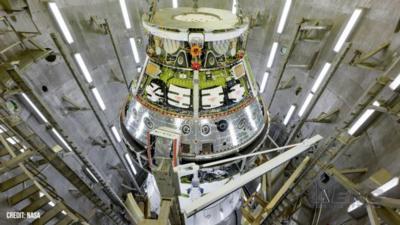
Aerospace giant Lockheed Martin recently turned in its share of the Artemis II venture, delivering its Orion spacecraft to the NASA Exploration Ground Systems team. This will be used to take four astronauts to the moon in early 2026.

"This achievement is a testament to our employees and suppliers who have worked tirelessly to get us to this important milestone," stated Kirk Shireman, Lockheed Martin’s vice president of Human Space Exploration and Orion program manager. "The Orion spacecraft completion for Artemis II is a major step forward in our nation's efforts to develop a long-term lunar presence."

Lockheed Martin was awarded a multi-mission NASA contract for long-term production of the advanced, human-rated, deep space Orion spacecraft in September 2019. This contract, also known as the Orion Production and Operations Contract (OPOC), details up to 12 spacecraft and should keep the space agency covered well into the 2030s.

The completed Artemis II Orion spacecraft was officially delivered to NASA on May 1, 2025. It will now continue through launch processing, get propellants and other consumables loaded, and make its way onto the Space Launch System (SLS) rocket ahead of a crewed Lunar mission early next year.

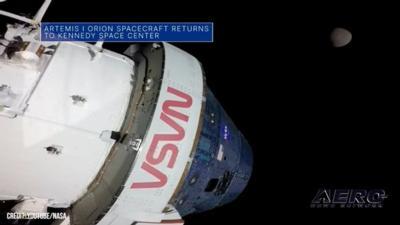
Though Orion has proven itself as a capable spacecraft time and time again, Artemis II will be its first crewed mission. The platform debuted on December 5, 2014, under NASA’s Exploration Flight Test 1 (EFT-1) mission and took its second flight through Artemis I in 2022.

To make the jump from uncrewed to crewed, Lockheed made several enhancements to the vehicle. It added systems for life support, controls, audio communications, exercise, and launch abort. High data-rate communications will be aided through an experimental laser communication system and docking sensors.

“It's exciting to think that soon, humans will see the Earth rise over the lunar horizon from our vehicle, while also traveling farther from Earth than ever before,” Shireman continued.

FMI: www.lockheedmartin.com/orion

Advertisement

More News

Classic Aero-TV: VerdeGo Debuts VH-3 Hybrid-Electric Powerplant

From 2023 (YouTube Edition): New Propulsion Scheme Optimized for AAM Applications Founded in 2017 by Eric Bartsch, Pat Anderson, and Erik Lindbergh (grandson of famed aviation pion>[...]

NTSB Prelim: Grumman American Avn. Corp. AA-5B

During The Initial Climb, The Engine Began To Operate Abnormally And, After About Three Seconds, Experienced A Total Loss Of Power On October 29, 2025, about 1820 Pacific daylight >[...]

ANN's Daily Aero-Linx (12.02.25)

Aero Linx: Women in Aviation International Women in Aviation International is the largest nonprofit organization that envisions a world where the sky is open to all, and where avia>[...]

Aero-News: Quote of the Day (12.02.25)

“We’ve paid for the cable line’s repair for the customer and have apologized for the inconvenience this caused them...” Source: Some followup info from an A>[...]

Aero-News: Quote of the Day (12.03.25)

“We have long warned about the devastating effects of pairing optimization. Multiple times over many months, we highlighted how schedule manipulation, unbalanced schedules, a>[...]

blog comments powered by Disqus



Advertisement

Advertisement

Podcasts

Advertisement

© 2007 - 2025 Web Development & Design by Pauli Systems, LC

