MAVEN To Answer Questions About How Mars Lost Its Atmosphere
A NASA spacecraft that will examine the upper atmosphere of Mars in unprecedented detail is undergoing final preparations for a scheduled 1328 EST Monday, Nov. 18 launch from Cape Canaveral Air Force Station in Florida. The Mars Atmosphere and Volatile Evolution mission (MAVEN) will examine specific processes on Mars that led to the loss of much of its atmosphere. Data and analysis could tell planetary scientists the history of climate change on the Red Planet and provide further information on the history of planetary habitability.
"The MAVEN mission is a significant step toward unraveling the planetary puzzle about Mars' past and present environments," said John Grunsfeld, associate administrator for NASA's Science Mission Directorate in Washington. "The knowledge we gain will build on past and current missions examining Mars and will help inform future missions to send humans to Mars."
The 5,410-pound spacecraft will launch aboard a United Launch Alliance Atlas V 401 rocket on a 10-month journey to Mars. After arriving at Mars in September 2014, MAVEN will settle into its elliptical science orbit. Over the course of its one-Earth-year primary mission, MAVEN will observe all of Mars' latitudes. Altitudes will range from 93 miles to more than 3,800 miles. During the primary mission, MAVEN will execute five deep dip maneuvers, descending to an altitude of 78 miles. This marks the lower boundary of the planet's upper atmosphere. "Launch is an important event, but it's only a step along the way to getting the science measurements," said Bruce Jakosky, principal investigator at the University of Colorado, Boulder's Laboratory for Atmospheric and Space Physics (CU/LASP) in Boulder. "We're excited about the science we'll be doing, and are anxious now to get to Mars."
The MAVEN spacecraft will carry three instrument suites. The Particles and Fields Package, provided by the University of California at Berkeley with support from CU/LASP and NASA's Goddard Space Flight Center in Greenbelt, MD, contains six instruments to characterize the solar wind and the ionosphere of Mars. The Remote Sensing Package, built by CU/LASP, will determine global characteristics of the upper atmosphere and ionosphere. The Neutral Gas and Ion Mass Spectrometer, built by Goddard, will measure the composition of Mars’ upper atmosphere.
"When we proposed and were selected to develop MAVEN back in 2008, we set our sights on Nov. 18, 2013, as our first launch opportunity," said Dave Mitchell, MAVEN project manager at Goddard. "Now we are poised to launch on that very day. That's quite an accomplishment by the team."
MAVEN's principal investigator is based at CU/LASP. The university provided science instruments and leads science operations, as well as education and public outreach, for the mission.
Goddard manages the project and provided two of the science instruments for the mission. Lockheed Martin built the spacecraft and is responsible for mission operations. The University of California at Berkeley's Space Sciences Laboratory provided science instruments for the mission. NASA's Jet Propulsion Laboratory in Pasadena, CA, provides navigation support, Deep Space Network support, and Electra telecommunications relay hardware and operations.
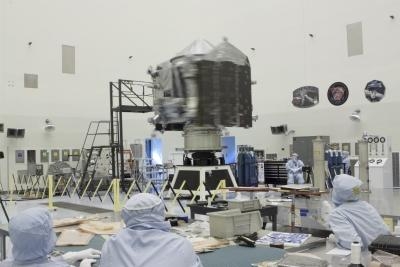
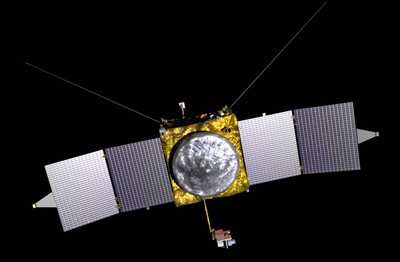
(Pictured Top: Inside the Payload Hazardous Servicing Facility at NASA's Kennedy Space Center in Florida, engineers and technicians perform a spin test of the Mars Atmosphere and Volatile Evolution, or MAVEN, spacecraft. Lower image from file artist's concept of MAVEN spacecraft)



 NTSB Prelim: Cirrus Design Corp SR20


 See All