
MSU's Raspet Flight Research Lab Designated As FAA UAS Safety Research Facility | Aero-News Network
Aero-News Network
RSS icon RSS feed
podcast icon MP3 podcast
Subscribe Aero-News e-mail Newsletter Subscribe

Airborne Unlimited -- Most Recent Daily Episodes

Episode Date

Airborne-Monday

Airborne-Tuesday

Airborne-Wednesday Airborne-Thursday

Airborne-Friday

Airborne On YouTube

Airborne-Unlimited-12.08.25

AirborneNextGen-
12.09.25

Airborne-Unlimited-12.10.25

Airborne-AffordableFlyers-12.11.25

AirborneUnlimited-12.05.25

AFE 2025 LIVE MOSAIC Town Hall (Archived): www.airborne-live.net

Fri, Jun 26, 2020

MSU's Raspet Flight Research Lab Designated As FAA UAS Safety Research Facility

Raspet Already Conducts The Vast Majority Of Safety-Related UAS Research For Civil Use

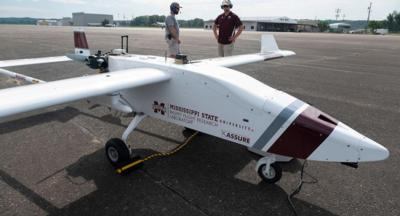
Mississippi State University’s (MSU) Raspet Flight Research Laboratory has been designated as the FAA’s UAS Safety Research Facility. This designation puts the research center at the forefront of studying and developing safety and certification standards as UAS continue to be integrated into U.S. airspace.

“Mississippi State University is a national research leader in many fields, and our foundational work with unmanned aircraft has positioned us, as this selection demonstrates, to help write the flight safety plan for this potentially transformational aspect of the aviation industry,” says MSU President Mark E. Keenum.

“This designation further solidifies MSU and the state of Mississippi as a leader in unmanned aircraft systems, which will bring more academic, research and economic opportunities to our state.”

In collaboration with its partner universities in the FAA’s UAS Center of Excellence, Raspet already conducts the vast majority of safety-related UAS research for civil use. The Center of Excellence—known as the Alliance for System Safety of UAS through Research Excellence (ASSURE)—is a leading research coalition of 25 universities and more than 100 government and industry partners.

MSU notes that integrating UAS into the National Airspace System would enable manned and unmanned aircraft to safely operate alongside each other using many of the same air traffic management systems and procedures.

In its role as the UAS Safety Research Facility, Raspet will address several issues including: “Validating and verifying results, recommendations and conclusions of UAS safety research from around the world; developing safety-based recommendations to inform FAA decisions on UAS policy, regulation and safety guidance; investigating technologies that enable UAS to accurately and reliably detect other aircraft and adjust the course of the UAS to maintain safe distances; successful implementation of these detect-and-avoid systems would permit UAS to safely operate beyond visual line of sight—a critical threshold for UAS to reach full potential; and serving as a performance evaluation testbed for emerging UAS technologies.”

“Raspet has a rich heritage of aviation development and testing, and we’re building upon that foundation by providing the FAA with research needed to quickly, safely and efficiently integrate UAS into the National Airspace System,” says Dallas Brooks, Raspet director.

“We’re proud the FAA has selected us as their UAS Safety Research Facility, and we’re looking forward to working together to ensure the benefits of this amazing technology are realized without compromising safety.”

FMI: www.raspet.msstate.edu

Advertisement

More News

Aero-News: Quote of the Day (12.09.25)

“We respectfully call on the City of Mesa to: 1. Withdraw the landing fee proposal immediately 2. Engage with the aviation community before making decisions that impact safet>[...]

ANN's Daily Aero-Term (12.09.25): High Speed Taxiway

High Speed Taxiway A long radius taxiway designed and provided with lighting or marking to define the path of aircraft, traveling at high speed (up to 60 knots), from the runway ce>[...]

ANN's Daily Aero-Linx (12.09.25)

Aero Linx: International Federation of Airworthiness (IFA) IFA uniquely combines together all those with responsibility for policies, principles and practices concerned with the co>[...]

NTSB Final Report: Diamond Aircraft Ind Inc DA20C1 (A1); Robinson Helicopter R44

Controller’s Expectation That VW02 Would Have Departed Sooner Led To An Inadequate Scan And Loss Of Situational Awareness Analysis: A Robinson R-44 helicopter N744AF, VW02 (V>[...]

ANN FAQ: Q&A 101

A Few Questions AND Answers To Help You Get MORE Out of ANN! 1) I forgot my password. How do I find it? 1) Easy... click here and give us your e-mail address--we'll send it to you >[...]

blog comments powered by Disqus



Advertisement

Advertisement

Podcasts

Advertisement

© 2007 - 2025 Web Development & Design by Pauli Systems, LC

