Unusual System Is About 8,000 Light Years From Earth
Two's company, but three might not always be a crowd - at least in space.
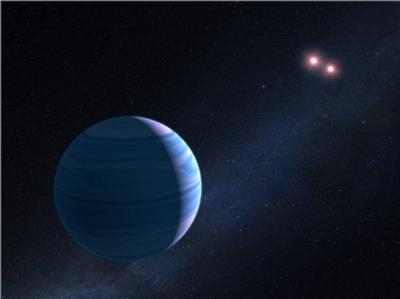
Astronomers using NASA's Hubble Space Telescope, and a trick of nature, have confirmed the existence of a planet orbiting two stars in the system OGLE-2007-BLG-349, located 8,000 light-years away towards the center of our galaxy.
The planet orbits roughly 300 million miles from the stellar duo, about the distance from the asteroid belt to our sun. It completes an orbit around both stars roughly every seven years. The two red dwarf stars are a mere 7 million miles apart, or 14 times the diameter of the moon's orbit around Earth.
The Hubble observations represent the first time such a three-body system has been confirmed using the gravitational microlensing technique. Gravitational microlensing occurs when the gravity of a foreground star bends and amplifies the light of a background star that momentarily aligns with it. The particular character of the light magnification can reveal clues to the nature of the foreground star and any associated planets.
The three objects were discovered in 2007 by an international collaboration of five different groups: Microlensing Observations in Astrophysics (MOA), the Optical Gravitational Lensing Experiment (OGLE), the Microlensing Follow-up Network (MicroFUN), the Probing Lensing Anomalies Network (PLANET), and the Robonet Collaboration. These ground-based observations uncovered a star and a planet, but a detailed analysis also revealed a third body that astronomers could not definitively identify.
"The ground-based observations suggested two possible scenarios for the three-body system: a Saturn-mass planet orbiting a close binary star pair or a Saturn-mass and an Earth-mass planet orbiting a single star," explained David Bennett of the NASA Goddard Space Flight Center in Greenbelt, Maryland, the paper's first author.
The sharpness of the Hubble images allowed the research team to separate the background source star and the lensing star from their neighbors in the very crowded star field. The Hubble observations revealed that the starlight from the foreground lens system was too faint to be a single star, but it had the brightness expected for two closely orbiting red dwarf stars, which are fainter and less massive than our sun. "So, the model with two stars and one planet is the only one consistent with the Hubble data," Bennett said.
Bennett's team conducted the follow-up observations with Hubble's Wide Field Planetary Camera 2. "We were helped in the analysis by the almost perfect alignment of the foreground binary stars with the background star, which greatly magnified the light and allowed us to see the signal of the two stars," Bennett explained.
Kepler has discovered 10 other planets orbiting tight binary stars, but these are all much closer to their stars than the one studied by Hubble.
Now that the team has shown that microlensing can successfully detect planets orbiting double-star systems, Hubble could provide an essential role in this new realm in the continued search for exoplanets.
The team's results have been accepted for publication in The Astronomical Journal.
(Image provided with NASA news release)



 NTSB Prelim: Cirrus Design Corp SR20


 See All