
Tradition Meets Cutting-Edge In New Cockpit Instrumentation | Aero-News Network
Aero-News Network
RSS icon RSS feed
podcast icon MP3 podcast
Subscribe Aero-News e-mail Newsletter Subscribe

Airborne Unlimited -- Most Recent Daily Episodes

Episode Date

Airborne-Monday

Airborne-Tuesday

Airborne-Wednesday Airborne-Thursday

Airborne-Friday

Airborne On YouTube

Airborne-Unlimited-12.08.25

AirborneNextGen-
12.09.25

Airborne-Unlimited-12.10.25

Airborne-AffordableFlyers-12.11.25

AirborneUnlimited-12.12.25

AFE 2025 LIVE MOSAIC Town Hall (Archived): www.airborne-live.net

Mon, Mar 12, 2018

Tradition Meets Cutting-Edge In New Cockpit Instrumentation

Airbus Brings Two Projects Together In Modernizing The Primary Flight Display

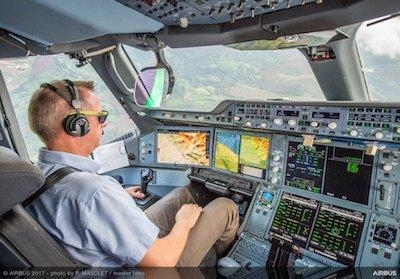
Since the earliest days of flight, the aviation sector has worked to develop better ways for pilots to understand their aircraft’s position relative to the ground. The evolution has gone from visual cues outside the aircraft to in-cockpit digital displays with data-rich views of the environment – and innovators at Airbus are ready to improve this instrumentation once again.

A cornerstone of today’s cockpits is the Primary Flight Display (PFD), an electronic instrument that brings together the functions of six previously separate gauges on the panel: the airspeed indicator, attitude indicator, altimeter, turn coordinator, horizontal situation indicator and vertical speed indicator.

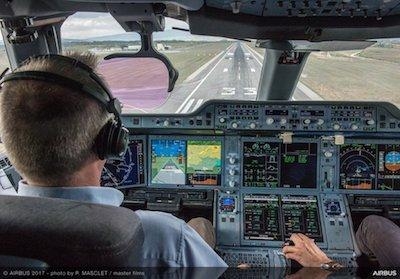
“Every generation of PFD gave pilots a better version of what they already were used to,” explained Fabrice Bousquet, an Airbus vision systems expert. “In 2015, we started working on a research and technology project that would break with tradition to exploit the full potential of modern screen technology – giving pilots their data superimposed onto a nearly-real visual representation of where they’re heading.”

This led to development of a synthetic vision system (or SVS) that received a positive response from pilots during flight tests. Crucial to the SVS’ success was Airbus’ work on another project – the primary full-format flight display (PF3D) – because, without changes, older-generation PFDs would have degraded the visual dimension of information being presented.

“We had to adapt the scales because they weren’t uniform across the display, which would have resulted in natural features like mountains being flattened,” explained Alexis Frenot, the SVS and PF3D project leader. “We also needed the capacity to show pilots their trajectory. While existing PFDs give pilots the information needed to work this out for themselves, our new system actually shows them.”

Teams for the SVS and PF3D systems have now merged and are conducting feasibility studies in advance of the display’s anticipated commercial service entry in 2021. “We know from customer focus groups that airlines and their pilots would like to have cockpits with this technology,” said Frenot, “and that they value the added situational awareness it provides.”

The combined team is confident these new displays will become the norm. “We have a wave of pilots who grew up with information-rich screens, and the benefits are obvious to them,” concludes Frenot. “Add the ability to ‘see’, even at night and in poor conditions, and you have the best of the old and the new combined.”

(Images provided with Airbus news release)

FMI: www.airbus.com

Advertisement

More News

Aero-News: Quote of the Day (12.11.25)

"The owners envisioned something modern and distinctive, yet deeply meaningful. We collaborated closely to refine the flag design so it complemented the aircraft’s contours w>[...]

ANN's Daily Aero-Term (12.11.25): Nonradar Arrival

Nonradar Arrival An aircraft arriving at an airport without radar service or at an airport served by a radar facility and radar contact has not been established or has been termina>[...]

Classic Aero-TV: David Uhl and the Lofty Art of Aircraft Portraiture

From 2022 (YouTube Edition): Still Life with Verve David Uhl was born into a family of engineers and artists—a backdrop conducive to his gleaning a keen appreciation for the >[...]

Airborne-NextGen 12.09.25: Amazon Crash, China Rocket Accident, UAV Black Hawk

Also: Electra Goes Military, Miami Air Taxi, Hypersonics Lab, MagniX HeliStrom Amazon’s Prime Air drones are back in the spotlight after one of its newest MK30 delivery drone>[...]

Airborne 12.05.25: Thunderbird Ejects, Lost Air india 737, Dynon Update

Also: Trailblazing Aviator Betty Stewart, Wind Farm Scrutiny, Chatham Ban Overturned, Airbus Shares Dive A Thunderbird pilot, ID'ed alternately as Thunderbird 5 or Thunderbird 6, (>[...]

blog comments powered by Disqus



Advertisement

Advertisement

Podcasts

Advertisement

© 2007 - 2025 Web Development & Design by Pauli Systems, LC

