Lynn Kelly, president of Kelly Aviation company of Grenola (KS),
had something so new at Oshkosh that the website wasn't ready: the
PCM-1000. He pulled our reporter over to show him...
What's a PCM-1000? It stands for "Personal Cabin Monitor," but
it's more than that: it's a shirt-pocket-size timing device, hi-lo
altitude bug, altimeter, density-altitude meter, hypoxia alert
thingie, with an AGL feature in it, too. All this, and it's about
the size of a couple beepers stacked atop one another.
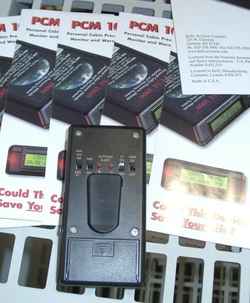
Developed as a result of the Payne Stewart accident...
NASA developed this, and has made it available to the public
through Kelly as a licensee, in part due to the type of accident
that killed pro golfer Payne Stewart, whose chartered Learjet lost
pressure and continued on its autopilot-guided path, after all
aboard had lost consciousness in a depressurization accident nearly
four years ago.
This 6.3 ounce (with two AA batteries) machine can alert a pilot
when he's approaching a hypoxic condition, or keep him warned if he
strays outside a pilot-preference altitude window. It's also an
accurate altimeter, set to either standard or actual pressure.
If a pilot flies at 12,500 feet for half an hour, a vibrator,
light, and warning tone all go off, to remind the pilot that it's
time for auxilary oxygen. If 14,000 feet is reached, the same thing
happens.
At lower altitudes, the PCM-1000 can help you not bust airspace.
It can be set to keep you between two altitudes, programmable in
10-foot intervals. Try this: set the altimeter to the barometric
pressure, and cross-check with your aircraft's altimeter, just to
be sure. That will show where you are. Now, set the altitude below
which you don't want to fly; then the altitude above which you do
not want to fly. If you stray outside those limits, the PCM-1000
will vibrate; and light and beep intermittently, until
you either reset it or get back into your altitude envelope.
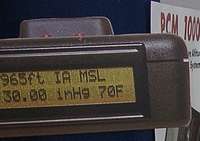 It checks altitude 100 times a
second; and it can be used as a backup altimeter, as well; or as an
"AGL meter," for local flights, balloons, or gliders. It reads
altitude in 3-foot increments, too; so "off-label" uses --
mountain and canyon climbers, for instance -- find it
useful. Race car and motorcycle tuners have used this device, as
well, to map their engines to the track's density altitude.
It checks altitude 100 times a
second; and it can be used as a backup altimeter, as well; or as an
"AGL meter," for local flights, balloons, or gliders. It reads
altitude in 3-foot increments, too; so "off-label" uses --
mountain and canyon climbers, for instance -- find it
useful. Race car and motorcycle tuners have used this device, as
well, to map their engines to the track's density altitude.
If you fly in a pressurized cabin, it's a great monitor, to make
sure your cabin altitude isn't climbing. for instance, if you have
an 8000 foot cabin, and you set the altitude alert to go off at
9000 feet, you'll have plenty of time to react to a pressure drop.
A slow drop in pressure, over a long flight, can be an insidious
killer.
Since it's as portable as your shirt pocket (it also has a belt
hook), the PCM-1000 could be used by the motorcycle racer who
climbs mountains to reach the airport -- and it would be useful all
along that trip. Since it's so accurate, it's a viable backup
altimeter, too.
The small but readable face has a backlight; with "the worst AA
betteries we could get," Mr. Kelly told us, "it will go 50 hours or
so with the light on. Those AAs seem to last at least 3 months in
normal use, too."
At Oshkosh, Kelly told us that the website price is
introductory, and fifty bucks cheaper than the MSRP of $450.



 ANN's Daily Aero-Linx (12.12.25)


 See All