
Triton Unmanned Aircraft Wing Strength Exceeds Navy Requirement | Aero-News Network
Aero-News Network
RSS icon RSS feed
podcast icon MP3 podcast
Subscribe Aero-News e-mail Newsletter Subscribe

Airborne Unlimited -- Most Recent Daily Episodes

Episode Date

Airborne-Monday

Airborne-Tuesday

Airborne-Wednesday Airborne-Thursday

Airborne-Friday

Airborne On YouTube

Airborne-Unlimited-12.01.25

AirborneNextGen-
12.02.25

Airborne-Unlimited-12.03.25

Airborne-AffordableFlyers-11.20.25

AirborneUnlimited-11.21.25

LIVE MOSAIC Town Hall (Archived): www.airborne-live.net

Tue, Nov 05, 2013

Triton Unmanned Aircraft Wing Strength Exceeds Navy Requirement

NGC, Triumph Aerostructures Validate Structural Strength Of The Airfoil

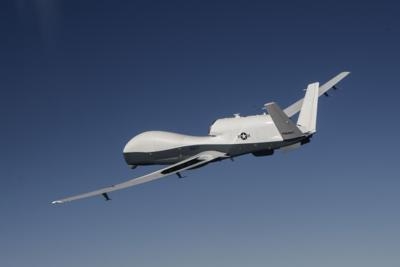
Northrop Grumman and Triumph Aerostructures – Vought Aircraft Division have successfully demonstrated the structural strength of the U.S. Navy's Triton unmanned aircraft system (UAS) wing. The companies say this is a key capability that will allow the aircraft to descend from high altitudes to make positive identification of targets of interest during surveillance missions.

A team of engineers found that no failures or unacceptable deformations of the wing occurred when it was subjected to a load at 22 percent above the Navy's requirement. "During surveillance missions using Triton, Navy operators may spot a target of interest and order the aircraft to a lower altitude to make positive identification," said Mike Mackey, Northrop Gumman's Triton UAS program director. "The wing's strength allows the aircraft to safely descend, sometimes through weather patterns, to complete this maneuver."
 
Northrop Grumman's wing supplier for its portfolio of high-altitude, long-endurance unmanned aircraft systems is Triumph Aerostructures, a Vought Aircraft Division. The testing was conducted at their facility in Dallas. Additional steps needed to certify the wing's life span include flight tests at various weights placed within the wing that simulate various fuel loads and a fatigue test of the entire airframe that will begin in 2017.
 
The MQ-4C Triton will provide long-range intelligence, surveillance and reconnaissance to Navy commanders as a complement to the manned P-8 Poseidon maritime patrol aircraft. Using a specialized suite of sensors that sweep in a 360-degree field of view, Triton can monitor more than one million square miles of ocean in a single mission.

(Image provided by Northrop Grumman)

FMI: www.northropgrumman.com

Advertisement

More News

Classic Aero-TV: VerdeGo Debuts VH-3 Hybrid-Electric Powerplant

From 2023 (YouTube Edition): New Propulsion Scheme Optimized for AAM Applications Founded in 2017 by Eric Bartsch, Pat Anderson, and Erik Lindbergh (grandson of famed aviation pion>[...]

NTSB Prelim: Grumman American Avn. Corp. AA-5B

During The Initial Climb, The Engine Began To Operate Abnormally And, After About Three Seconds, Experienced A Total Loss Of Power On October 29, 2025, about 1820 Pacific daylight >[...]

ANN's Daily Aero-Linx (12.02.25)

Aero Linx: Women in Aviation International Women in Aviation International is the largest nonprofit organization that envisions a world where the sky is open to all, and where avia>[...]

Aero-News: Quote of the Day (12.02.25)

“We’ve paid for the cable line’s repair for the customer and have apologized for the inconvenience this caused them...” Source: Some followup info from an A>[...]

Aero-News: Quote of the Day (12.03.25)

“We have long warned about the devastating effects of pairing optimization. Multiple times over many months, we highlighted how schedule manipulation, unbalanced schedules, a>[...]

blog comments powered by Disqus



Advertisement

Advertisement

Podcasts

Advertisement

© 2007 - 2025 Web Development & Design by Pauli Systems, LC

