Uncommanded Activation Of Its Emergency Automatic Landing System
Location: Austin, TX Incident Number: DCA24LA328
Date & Time: September 14, 2024, 12:48 Local Registration: N442CV
Aircraft: Cirrus Design Corp SF50 Injuries: 1 None
Flight Conducted Under: Part 91: General aviation - Personal

On September 14, 2024, at 1248 central daylight time, a Cirrus SF50, N442CV, experienced an uncommanded activation of its emergency automatic landing system soon after the airplane was struck by an unknown object during approach into Austin Bergstrom International Airport (AUS), Austin, Texas. The airplane sustained minor damage due to the impact and the pilot was not injured. The airplane was operated as a Title 14 Code of Federal Regulations Part 91 personal flight from Cincinnati Municipal Airport/Lunken Field (LUK), Cincinnati, Ohio to AUS.
Object Strike: According to the pilot, during approach into AUS, he thought a bird struck the right windscreen and damaged the interior sun visor near the top. However, a photograph provided by the airplane manufacturer, Cirrus Aircraft, showed scraping and blue, red, and white color transfer marks that extended diagonally from the bottom of the right windscreen near the center post toward the top and outboard side the windscreen. The pilot reported that after landing, he wiped the airplane down and noted there was an “oily residue” on the windscreen.
He did not retain any samples of the residue.
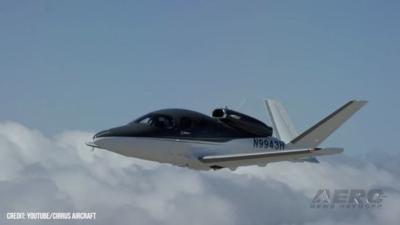
Emergency Autoland: The pilot stated that the impact resulted in the activation of the airplane’s Emergency Autoland (EA) sequence. Preliminary information recovered from the airplane’s central maintenance computer indicated that at 1248, while about 1,540 ft above ground level and at a speed of 167 knots, the “Emergency Autoland Activating” warning message was presented in the cockpit for 10 seconds, followed by activation of the EA, which lasted for about 10 seconds before it was deactivated. About 4-5 seconds later, the “Emergency Autoland Activating” warning message was again presented for 10 seconds, before the EA activated for the 2nd time. EA was deactivated 9 seconds later and remained deactivated. After which the pilot was able to land the airplane uneventfully at AUS.
The Emergency Autoland system is designed to land the airplane automatically in the event the pilot becomes incapacitated. The system can be activated:
1) by pressing a pushbutton located in the center of the overhead console (about 2 ft aft of the top of the windscreen),
2) if the Automatic Level mode is engaged for 1 minute, or,
3) if the Emergency Descent Mode is active and the airplane descends through 15,000 ft.
Once activated, the system enters a 10 second waiting period and provides visual and aural warnings of the impending EA sequence. The system can be deactivated at any time (during the waiting period or after) with the red autopilot disconnect button, located on the pilot side stick.
After the waiting period, it will provide information on the instrument displays, tune the communication radios and broadcast automated messages, set the transponder to 7700, select a destination airport and generate a route to that airport. On approach, it will deploy the flaps, extend the landing gear and follow GPS guidance to the runway. After touchdown it will de-rotate the airplane and apply the wheel brakes.
Data files were downloaded from the airplane’s on-board Recoverable Data Module by the airframe manufacturer and forwarded to the NTSB for examination. National Transportation Safety Board systems and recorder specialists were assigned to assist in the investigation of the incident. Parties to the investigation are the Federal Aviation Administration and Cirrus Aircraft.
The investigation is continuing.



 ANN's Daily Aero-Term (12.01.25): Convective SIGMET


 See All