

Drones Named As Top Culprit for Near-Miss Incidents | Aero-News Network
Aero-News Network
RSS icon RSS feed
podcast icon MP3 podcast
Subscribe Aero-News e-mail Newsletter Subscribe

Airborne Unlimited -- Most Recent Daily Episodes

Episode Date

Airborne-Monday

Airborne-Tuesday

Airborne-Wednesday Airborne-Thursday

Airborne-Friday

Airborne On YouTube

Airborne-Unlimited-12.01.25

AirborneNextGen-
12.02.25

Airborne-Unlimited-12.03.25

Airborne-FltTraining-12.04.25

AirborneUnlimited-12.05.25

AFE 2025 LIVE MOSAIC Town Hall (Archived): www.airborne-live.net

Mon, May 05, 2025

Drones Named As Top Culprit for Near-Miss Incidents

Study Blames Drones for Two-Thirds of Close Calls With Airliners

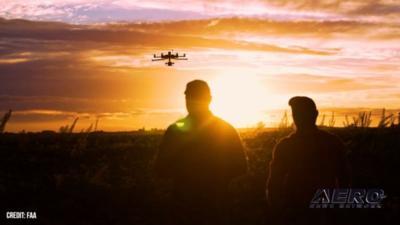
A recent analysis claims that drones are responsible for up to two-thirds of near-misses with commercial aircraft at America’s busiest airports. The FAA has taken steps to avoid these events, but the spike in unauthorized drone flights certainly is not aiding their cause.

Drone-related near-misses have been reported for over a decade, since around the same time that the devices started becoming commonplace. Since 2014, 51% of near-miss events have listed drones as the cause, making them responsible for 122 incidents. The number of reports last peaked in 2020 as air traffic hit a low point.

There have been several recent high-profile near-misses involving drones, many being a little too close for comfort. In November, a commercial jet on final approach to San Francisco International Airport (SFO) spotted a drone ahead. It was unable to “take evasive action,” the crew said, and was forced to watch as the drone passed just a couple hundred feet off the nose.

Shortly earlier, in August, a drone came within 50 feet of the left wing of an airliner that was departing New Jersey’s Newark Liberty International Airport (EWR). Another ‘close encounter’ was reported by a jetliner near Miami International Airport (MIA), and countless more since.

In the US, drones are restricted to flying in the airspace below 400 feet above ground level (AGL) to keep a 100-foot buffer from most manned aircraft. This altitude restriction drops lower, or even to zero, in certain controlled airspace or no-fly zones.

In theory, this ceiling would keep most unmanned activities separate from manned aircraft. However, with how accessible drones have become, many remote pilots are unaware of airspace-specific requirements and may unintentionally put themselves in the direct path of landing aircraft. The fact that popular drone manufacturers, like DJI, have removed their ‘geofencing systems’ that used to help controllers avoid airspace restrictions does not aid the situation.

The FAA is looking at various methods that could potentially lower the frequency of these incidents, but there is no guarantee that it will be effective or soon enough to prevent something more than a near-miss.

FMI: www.faa.gov

Advertisement

More News

Classic Aero-TV: VerdeGo Debuts VH-3 Hybrid-Electric Powerplant

From 2023 (YouTube Edition): New Propulsion Scheme Optimized for AAM Applications Founded in 2017 by Eric Bartsch, Pat Anderson, and Erik Lindbergh (grandson of famed aviation pion>[...]

NTSB Prelim: Grumman American Avn. Corp. AA-5B

During The Initial Climb, The Engine Began To Operate Abnormally And, After About Three Seconds, Experienced A Total Loss Of Power On October 29, 2025, about 1820 Pacific daylight >[...]

ANN's Daily Aero-Linx (12.02.25)

Aero Linx: Women in Aviation International Women in Aviation International is the largest nonprofit organization that envisions a world where the sky is open to all, and where avia>[...]

Aero-News: Quote of the Day (12.02.25)

“We’ve paid for the cable line’s repair for the customer and have apologized for the inconvenience this caused them...” Source: Some followup info from an A>[...]

Aero-News: Quote of the Day (12.03.25)

“We have long warned about the devastating effects of pairing optimization. Multiple times over many months, we highlighted how schedule manipulation, unbalanced schedules, a>[...]

blog comments powered by Disqus



Advertisement

Advertisement

Podcasts

Advertisement

© 2007 - 2025 Web Development & Design by Pauli Systems, LC

