
Aergility’s Atlis UAV Shoulders Impressive Payload | Aero-News Network
Aero-News Network
RSS icon RSS feed
podcast icon MP3 podcast
Subscribe Aero-News e-mail Newsletter Subscribe

Airborne Unlimited -- Most Recent Daily Episodes

Episode Date

Airborne-Monday

Airborne-Tuesday

Airborne-Wednesday Airborne-Thursday

Airborne-Friday

Airborne On YouTube

Airborne-Unlimited-12.01.25

AirborneNextGen-
12.02.25

Airborne-Unlimited-11.19.25

Airborne-AffordableFlyers-11.20.25

AirborneUnlimited-11.21.25

LIVE MOSAIC Town Hall (Archived): www.airborne-live.net

Tue, Jun 21, 2022

Aergility’s Atlis UAV Shoulders Impressive Payload

Heavy Lifting via Heavy Thinking

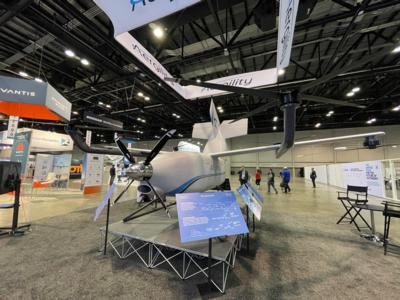
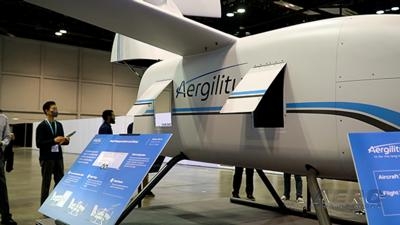
Aergility—the Florida-based company that develops and builds autonomous, long-range, high-payload, cargo-carrying, hybrid-electric, vertical takeoff and landing, unmanned aerial vehicles—has unveiled a prototype of its ATLIS UAV.

The vehicle’s long-range, heavy-lift capabilities are conducive to humanitarian, disaster-relief, military, and industrial missions conducted in areas where ground transportation is impossible, impractical, or flat-out dangerous.

At an empty weight of nine-hundred-pounds, a 15’ 4” longitudinal dimension, and a hefty, six-hundred-pound useful load, Atlis is a large UAV. Size, however, is among the lesser of Atlis’s distinctions. Engineers, aerodynamicists, and pilots are apt to be more impressed with Aergility’s patented, Managed Autorotation Technology, which enables Atlis to achieve transition-less flight from multi-rotor, vertical takeoff and landing to autogyro-like forward flight.

During vertical takeoff and landing, ATLIS’s battery-powered rotors behave like those of a conventional, multi-rotor drone. Once airborne, a diesel-burning, pusher, turboprop provides forward thrust. Thereafter, however, Atlis’s rotors go into a passive, autorotation mode (autogyro-style) and are managed by an onboard computer which controls the aircraft by varying individual rotor speeds. While in passive mode, the rotors regenerate the battery. Nifty, yes?

By dint of this clever syncretism of electrical, digital, gas-turbine, and aerodynamic technologies, Atlis can transport a five-hundred pound payload three-hundred miles at one-hundred miles-per-hour—a feat certain to raise eyebrows and interest among drone operators.

FMI: https://www.aergility.com

Advertisement

More News

ANN's Daily Aero-Term (12.01.25): Convective SIGMET

Convective SIGMET A weather advisory concerning convective weather significant to the safety of all aircraft. Convective SIGMETs are issued for tornadoes, lines of thunderstorms, e>[...]

ANN's Daily Aero-Linx (12.01.25)

Aero Linx: United Flying Octogenarians WELCOME to a most extraordinary group of aviators, the United Flying Octogenarians (UFO). Founded in 1982 with just a handful of pilots, we h>[...]

NTSB Final Report: Remos Aircraft GmbH Remos GX

Pilot’s Decision To Attempt Takeoff With Frost Covering The Airplane’s Wings Analysis: The pilot of the light sport airplane was preparing to depart for a cross-country>[...]

Aero-News: Quote of the Day (12.02.25)

“We’ve paid for the cable line’s repair for the customer and have apologized for the inconvenience this caused them...” Source: Some followup info from an A>[...]

ANN's Daily Aero-Term (12.02.25): Coupled Approach

Coupled Approach An instrument approach performed by the aircraft autopilot, and/or visually depicted on the flight director, which is receiving position information and/or steerin>[...]

blog comments powered by Disqus



Advertisement

Advertisement

Podcasts

Advertisement

© 2007 - 2025 Web Development & Design by Pauli Systems, LC

