
Cause Of SC King Air Accident Will Remain A Mystery | Aero-News Network
Aero-News Network
RSS icon RSS feed
podcast icon MP3 podcast
Subscribe Aero-News e-mail Newsletter Subscribe

Airborne Unlimited -- Most Recent Daily Episodes

Episode Date

Airborne-Monday

Airborne-Tuesday

Airborne-Wednesday Airborne-Thursday

Airborne-Friday

Airborne On YouTube

Airborne-Unlimited-12.01.25

AirborneNextGen-
12.02.25

Airborne-Unlimited-12.03.25

Airborne-AffordableFlyers-11.20.25

AirborneUnlimited-11.21.25

LIVE MOSAIC Town Hall (Archived): www.airborne-live.net

Thu, Jul 05, 2007

Cause Of SC King Air Accident Will Remain A Mystery

Pilot Told ATC Left Engine "Kept Power Up And Wouldn't Come Back"

A recently-issued National Transportation Safety Board probable cause report fails to shed any additional light on what may have caused a pilot to lose control of his aircraft in a North Myrtle Beach, SC accident that claimed the lives of a five-member family and their babysitter in 2006.

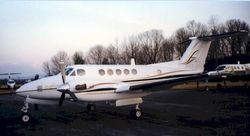
The pilot, Dr. Jon Kraut, 50, made two approaches at Grand Strand Airport February 3, 2006 in a Beechcraft King Air 200 (file photo of type, right). During the first approach, the aircraft was observed, "fish tailing" while about 30 feet over the runway, according to the NTSB report.

It then appeared to regain control and the pilot requested a go-around, according to witnesses. The air traffic controller asked Kraut if he were having problems with sea fog. He said no, the "left engine kept power up a little too much and would not come back."

After lining up for the second approach, witnesses report Kraut descended to the runway without any indication of trouble. The aircraft then "climbed and rolled left, went inverted and nosed down into the grass to the left of the runway and burst into flames."

The NTSB determined the probable cause to be "the pilot's failure to maintain control during (the) landing approach for undetermined reasons."

The investigation found no abnormal pre-impact conditions that would have interfered with the normal operation of the aircraft.

Krause held an ATP rating and had logged 3,400 hours, according to the NTSB report.

FMI: Read The NTSB Probable Cause Report

Advertisement

More News

Classic Aero-TV: VerdeGo Debuts VH-3 Hybrid-Electric Powerplant

From 2023 (YouTube Edition): New Propulsion Scheme Optimized for AAM Applications Founded in 2017 by Eric Bartsch, Pat Anderson, and Erik Lindbergh (grandson of famed aviation pion>[...]

NTSB Prelim: Grumman American Avn. Corp. AA-5B

During The Initial Climb, The Engine Began To Operate Abnormally And, After About Three Seconds, Experienced A Total Loss Of Power On October 29, 2025, about 1820 Pacific daylight >[...]

ANN's Daily Aero-Linx (12.02.25)

Aero Linx: Women in Aviation International Women in Aviation International is the largest nonprofit organization that envisions a world where the sky is open to all, and where avia>[...]

Aero-News: Quote of the Day (12.02.25)

“We’ve paid for the cable line’s repair for the customer and have apologized for the inconvenience this caused them...” Source: Some followup info from an A>[...]

Aero-News: Quote of the Day (12.03.25)

“We have long warned about the devastating effects of pairing optimization. Multiple times over many months, we highlighted how schedule manipulation, unbalanced schedules, a>[...]

blog comments powered by Disqus



Advertisement

Advertisement

Podcasts

Advertisement

© 2007 - 2025 Web Development & Design by Pauli Systems, LC

