 The first aircraft to fly by
pulsed-detonation engine power, along with associated hearing
protection technology -- both developed by the Air Force Research
Laboratory here -- became additions to the National Museum of the
U.S. Air Force during an Aug. 25 ceremony at the museum annex at
Wright-Pat. Members of the AFRL's Propulsion Directorate developed
the pulsed-detonation engine, which logged a record-breaking manned
flight Jan. 31 at Mojave, Calif.
The first aircraft to fly by
pulsed-detonation engine power, along with associated hearing
protection technology -- both developed by the Air Force Research
Laboratory here -- became additions to the National Museum of the
U.S. Air Force during an Aug. 25 ceremony at the museum annex at
Wright-Pat. Members of the AFRL's Propulsion Directorate developed
the pulsed-detonation engine, which logged a record-breaking manned
flight Jan. 31 at Mojave, Calif.
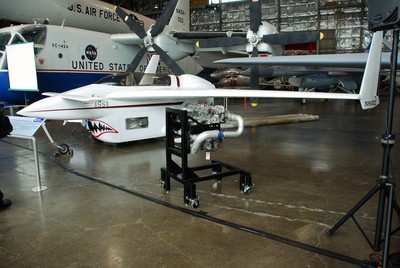
With test pilot Pete Siebold at the controls of the modified
Long EZ aircraft manufactured by Scaled Composites, the
pulsed-detonation engine, or PDE, achieved a speed of over 120 mph
and 60 to 100 feet altitude, producing more than 200 pounds of
thrust. It marked the first successful flight powered by
pulse-detonation technology.
During the flight, Mr. Siebold wore an Attenuating Custom
Communications Earpiece System, or ACCES, integrated with a
standard military flight helmet for acoustic protection from noise
generated by the engine. The deep-insert, custom-molded ACCES
technology is a product of an earlier collaboration between members
of the 711th Human Performance Wing's Warfighter Interface
Division, Battlespace Acoustics Branch and Westone Laboratories,
Inc., under a cooperative research and development agreement.
The demo flight culminated a collaborative effort led by
researchers in the Propulsion Directorate and its on-site
contractor Innovative Science Solutions, Inc. and supported by
those in AFRL's Human Effectiveness and Air Vehicles directorates.
The team overcame a multitude of technical challenges to prove that
pulse detonation is a feasible technology that would be more
economical and use less fuel than traditional jet engines.
Instead of burning fuel for propulsion, an air and fuel mixture
is ignited and detonated in repeated, controlled explosions inside
open-ended tubes resembling exhaust pipes. When detonation moves
through the tubes it creates a supersonic shockwave that
continually pulses and generates thrust.
Researchers from the 711th HPW determined acoustic exposure
limits and provided the hearing protection system. Noise levels in
the cockpit of the PDE-driven aircraft reach 130 decibels, compared
to about 100 decibels for a typical fighter jet, said AFRL research
audiologist John Hall. Without ACCES protection, a PDE pilot would
be unable to communicate with crew and would suffer hearing loss
after only two flights.
In presenting the hearing protection system to the museum, Mr.
Siebold said ACCES technology "allowed the flight to take place and
me to retain my hearing."
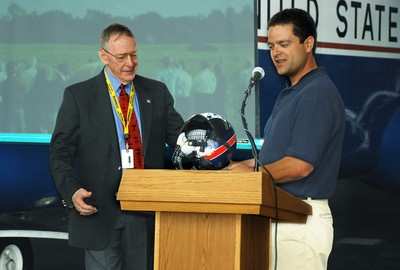
Both technologies were developed using off-the-shelf
components. The PDE incorporated an eight-cylinder automotive
engine and ACCES leveraged Westone's commercially available
communications equipment used by musicians.
According to Fred Schauer, PDE program team leader, the PDE
could be capable of powering future aircraft up to four times the
speed of sound.
"This engine offers the capability of static to near-hypersonic
flight with good supersonic efficiencies," he said. "PDEs could
make sense for missions that require efficient supersonic cruise
and/or boost from low to high speeds." [ANN Salutes John Schutte,
711th Human Performance Wing, for the story]



 Classic Aero-TV: Extra; the Airplane, the Man, and His Grand DeLand Plan


 See All