

NASA Draws On Apollo Lessons For Orion Landing Procedures | Aero-News Network
Aero-News Network
RSS icon RSS feed
podcast icon MP3 podcast
Subscribe Aero-News e-mail Newsletter Subscribe

Airborne Unlimited -- Most Recent Daily Episodes

Episode Date

Airborne-Monday

Airborne-Tuesday

Airborne-Wednesday Airborne-Thursday

Airborne-Friday

Airborne On YouTube

Airborne-Unlimited-12.08.25

AirborneNextGen-
12.09.25

Airborne-Unlimited-12.10.25

Airborne-AffordableFlyers-12.11.25

AirborneUnlimited-12.12.25

AFE 2025 LIVE MOSAIC Town Hall (Archived): www.airborne-live.net

Fri, Apr 13, 2007

NASA Draws On Apollo Lessons For Orion Landing Procedures

CEV Will Be Able To Land On Land, Or Water

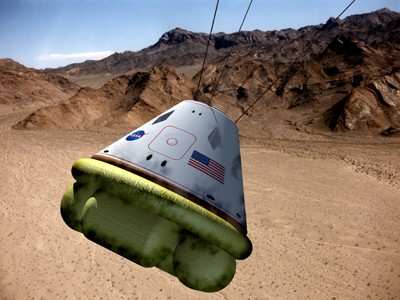
NASA's next manned spacecraft, the Orion, will parachute to the ground in the western United States at the end of its missions, much as Russia's Soyuz space capsules (and China's similar Shenzhou capsules) do today. Orion, however, will also have the ability to land in the ocean in the case of a launch failure, similar to the landings used during the Mercury, Gemini and Apollo missions... and that's an area many NASA engineers aren't as familiar with as they'd like to be.

To address the issue, NASA states its engineers (many of which were only children during the time of Apollo... or hadn't been born yet) are working with the military squadrons that will be responsible for rescue operations, as well as reaching out to veterans from the Apollo moon-landing project... to learn everything they can about capsule recovery operations.

"We want to get off on the right foot and make sure we're going to head down the right path. We want to learn from history and push forward and take it to the next level," said Brig. Gen. Susan Helms, commander of the Air Force's 45th Space Wing, which coordinates Department of Defense emergency support for US human spaceflight missions.

NASA and the Air Force are calling on the veterans from the Apollo program to advise those planning Orion recovery operations. The first in a series of meetings occurred at Patrick Air Force Base in Florida earlier this month.

One example of the benefits of such experience comes from the earliest days of NASA's manned missions. On the first two Mercury flights, helicopters simply dropped a cable to the bobbing spacecraft, and then lifted it out of the ocean and placed it on the deck of an awaiting ship. This practice changed when NASA's Liberty Bell 7 spacecraft sank, when the hatch inadvertently jettisoned after splashdown with astronaut Gus Grissom aboard.

After that incident, NASA began equipping its spacecrafts with floatation collars. The collars kept the craft afloat and provided a platform for recovery and rescue divers. The added buoyancy enabled the floating craft to come alongside ships, where cranes lifted them onto decks.

FMI: www.nasa.gov

Advertisement

More News

ANN's Daily Aero-Linx (12.12.25)

Aero Linx: Commercial Aviation Safety Team (CAST) Founded in 1997, the Commercial Aviation Safety Team (USCAST) has developed an integrated, data-driven strategy to reduce the comm>[...]

ANN's Daily Aero-Term (12.12.25): Land And Hold Short Operations

Land And Hold Short Operations Operations that include simultaneous takeoffs and landings and/or simultaneous landings when a landing aircraft is able and is instructed by the cont>[...]

ANN FAQ: How Do I Become A News Spy?

We're Everywhere... Thanks To You! Even with the vast resources and incredibly far-reaching scope of the Aero-News Network, every now and then a story that should be reported on sl>[...]

NTSB Final Report: Cirrus Design Corp SF50

Pilot’s Inadvertent Use Of The Landing Gear Control Handle Instead Of The Flaps Selector Switch During The Landing Rollout Analysis: The pilot reported that during the landin>[...]

Airborne 12.08.25: Samaritan’s Purse Hijack, FAA Med Relief, China Rocket Fail

Also: Cosmonaut Kicked Out, Airbus Scales Back, AF Silver Star, Russian A-60 Clobbered A Samaritan’s Purse humanitarian flight was hijacked on Tuesday, December 2, while atte>[...]

blog comments powered by Disqus



Advertisement

Advertisement

Podcasts

Advertisement

© 2007 - 2025 Web Development & Design by Pauli Systems, LC

