
NASA Launches Next-Generation Communications Satellite | Aero-News Network
Aero-News Network
RSS icon RSS feed
podcast icon MP3 podcast
Subscribe Aero-News e-mail Newsletter Subscribe

Airborne Unlimited -- Most Recent Daily Episodes

Episode Date

Airborne-Monday

Airborne-Tuesday

Airborne-Wednesday Airborne-Thursday

Airborne-Friday

Airborne On YouTube

Airborne-Unlimited-11.24.25

AirborneNextGen-
11.18.25

Airborne-Unlimited-11.19.25

Airborne-AffordableFlyers-11.20.25

AirborneUnlimited-11.21.25

LIVE MOSAIC Town Hall (Archived): www.airborne-live.net

Fri, Feb 01, 2013

NASA Launches Next-Generation Communications Satellite

Two Additional TDRS Spacecraft To Be Placed In Orbit Over The Next Two Years

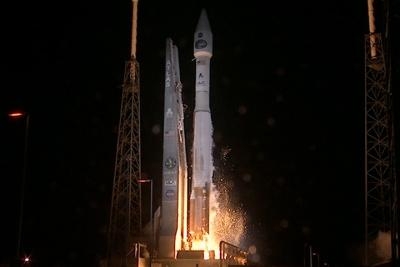
The first of NASA's three next-generation Tracking and Data Relay Satellites (TDRS), known as TDRS-K, launched at 8:48 p.m. EST Wednesday from Cape Canaveral Air Force Station in Florida. "TDRS-K bolsters our network of satellites that provides essential communications to support space exploration," said Badri Younes, deputy associate administrator for Space Communications and Navigation at NASA Headquarters in Washington. "It will improve the overall health and longevity of our system."

The TDRS system provides tracking, telemetry, command and high-bandwidth data return services for numerous science and human exploration missions orbiting Earth. These include the International Space Station and NASA's Hubble Space Telescope. "With this launch, NASA has begun the replenishment of our aging space network," said Jeffrey Gramling, TDRS project manager. "This addition to our current fleet of seven will provide even greater capabilities to a network that has become key to enabling many of NASA's scientific discoveries."

TDRS-K was lifted into orbit aboard a United Launch Alliance Atlas V rocket from Space Launch Complex-41. After a three-month test phase, NASA will accept the spacecraft for additional evaluation before putting the satellite into service.

The TDRS-K spacecraft includes several modifications from older satellites in the TDRS system, including redesigned telecommunications payload electronics and a high-performance solar panel designed for more spacecraft power to meet growing S-band requirements. Another significant design change, the return to ground-based processing of data, will allow the system to service more customers with evolving communication requirements. The next TDRS spacecraft, TDRS-L, is scheduled for launch in 2014. TDRS-M's manufacturing process will be completed in 2015.

(Image provided by NASA)

FMI: www.nasa.gov/tdrs

Advertisement

More News

ANN's Daily Aero-Term (11.28.25): Unmanned Aircraft System (UAS)

Unmanned Aircraft System (UAS) An unmanned aircraft and its associated elements related to safe operations, which may include control stations (ground, ship, or air based), control>[...]

ANN's Daily Aero-Linx (11.28.25)

Aero Linx: Cactus Fly-In The Classic Airplane Association of Arizona, Inc. (CAAA) was incorporated in Arizona as a not for profit corporation on January 10, 2014. The CAAA roster i>[...]

Airborne 11.21.25: NTSB on UPS Accident, Shutdown Protections, Enstrom Update

Also: UFC Buys Tecnams, Emirates B777-9 Buy, Allegiant Pickets, F-22 And MQ-20 The NTSB's preliminary report on the UPS Flight 2976 crash has focused on the left engine pylon's sep>[...]

Airborne 11.26.25: Bonanza-Baron Fini, Archer v LA NIMBYs, Gogo Loses$$$

Also: Bell 505 on SAF, NYPA Gets Flak For BizAv 'Abuse', FAA Venezuela Caution, Horizon Update Textron Aviation has confirmed it will be ending production of the Beechcraft Bonanza>[...]

Airborne-NextGen 11.25.25: EHang Manned Flt, Army UAVs, Starship V3 Booster Boom

Also: FedEx SAF, Archer Midnight Powertrain Tech, Rocket Lab Record, Perseverance Rover Find EHang has logged a major milestone in the development of its pilotless air taxi, loggin>[...]

blog comments powered by Disqus



Advertisement

Advertisement

Podcasts

Advertisement

© 2007 - 2025 Web Development & Design by Pauli Systems, LC

