

Mars-Bound Phoenix Probe Adjusts Course Successfully | Aero-News Network
Aero-News Network
RSS icon RSS feed
podcast icon MP3 podcast
Subscribe Aero-News e-mail Newsletter Subscribe

Airborne Unlimited -- Most Recent Daily Episodes

Episode Date

Airborne-Monday

Airborne-Tuesday

Airborne-Wednesday Airborne-Thursday

Airborne-Friday

Airborne On YouTube

Airborne-Unlimited-12.08.25

AirborneNextGen-
12.09.25

Airborne-Unlimited-12.10.25

Airborne-AffordableFlyers-12.11.25

AirborneUnlimited-12.12.25

AFE 2025 LIVE MOSAIC Town Hall (Archived): www.airborne-live.net

Sat, Aug 11, 2007

Mars-Bound Phoenix Probe Adjusts Course Successfully

Second Correction Planned For Mid-October

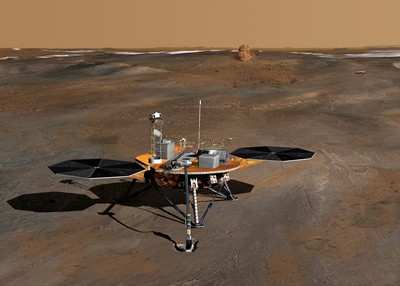
On Friday, NASA's Phoenix Mars Lander accomplished the first and largest of six course corrections planned during the spacecraft's flight from Earth to Mars.

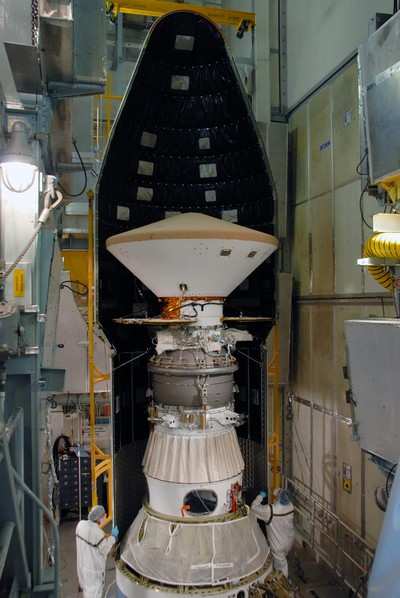
As ANN reported, Phoenix left Earth August 4, bound for a challenging touchdown on May 25, 2008, at a site farther north than any previous Mars landing. It will robotically dig to underground ice and run laboratory tests assessing whether the site could ever have been hospitable to microbial life.

Phoenix is traveling at about 33,180 meters per second (74,200 miles per hour) in relation to the sun. The first trajectory-correction maneuver was calculated to tweak the velocity by about 18.5 meters per second (41 miles per hour). The spacecraft fired its four mid-size thrusters for three minutes and 17 seconds to adjust its trajectory.

"All the subsystems are functioning as expected with few deviations from predicted performance," said Joe Guinn, Phoenix mission system manager at NASA's Jet Propulsion Laboratory in Pasadena, CA.

Key activities in the next few weeks will include checkouts of science instruments, radar and the communication system that will be used during and after the landing.

The second trajectory-correction maneuver is planned for mid-October.

"These first two together take out the bias intentionally put in at launch," said JPL's Brian Portock, Phoenix navigation team chief.

Without the correction maneuvers, the spacecraft's course after launch day would miss Mars by about 950,000 kilometers (590,000 miles), an intentional offset to prevent the third stage of the launch vehicle from hitting Mars.

NASA says the Delta II launch vehicle is not subject to the rigorous cleanliness requirements that the spacecraft must meet as a protection against letting Earth organisms get a foothold on Mars.

The burn began at 1130 Pacific Daylight Time. Each of the four trajectory-correction thrusters provides about 15.6 newtons (3.5 pounds) of force. Smaller, attitude-control thrusters pivoted the spacecraft to the desired orientation a few minutes before the main burn and returned it afterward to the right orientation for catching solar energy while communicating with Earth. Their thrust capacity is about 4.4 newtons (1 pound) apiece.

The twelve largest thrusters on Phoenix, delivering about 293 newtons (66 pounds) apiece, will operate only during the final minute before landing on Mars.

FMI: www.nasa.gov/constellation

Advertisement

More News

ANN's Daily Aero-Linx (12.12.25)

Aero Linx: Commercial Aviation Safety Team (CAST) Founded in 1997, the Commercial Aviation Safety Team (USCAST) has developed an integrated, data-driven strategy to reduce the comm>[...]

ANN's Daily Aero-Term (12.12.25): Land And Hold Short Operations

Land And Hold Short Operations Operations that include simultaneous takeoffs and landings and/or simultaneous landings when a landing aircraft is able and is instructed by the cont>[...]

ANN FAQ: How Do I Become A News Spy?

We're Everywhere... Thanks To You! Even with the vast resources and incredibly far-reaching scope of the Aero-News Network, every now and then a story that should be reported on sl>[...]

NTSB Final Report: Cirrus Design Corp SF50

Pilot’s Inadvertent Use Of The Landing Gear Control Handle Instead Of The Flaps Selector Switch During The Landing Rollout Analysis: The pilot reported that during the landin>[...]

Airborne 12.08.25: Samaritan’s Purse Hijack, FAA Med Relief, China Rocket Fail

Also: Cosmonaut Kicked Out, Airbus Scales Back, AF Silver Star, Russian A-60 Clobbered A Samaritan’s Purse humanitarian flight was hijacked on Tuesday, December 2, while atte>[...]

blog comments powered by Disqus



Advertisement

Advertisement

Podcasts

Advertisement

© 2007 - 2025 Web Development & Design by Pauli Systems, LC

