Fri, Sep 23, 2016
Issues Call For White Papers That Address Challenges In Five Key Areas
NASA is seeking innovative technology for the agency’s future exploration missions in the solar system and beyond, including the Journey to Mars, from other U.S. government agencies, academia, the aerospace industry and the public through the new iTech initiative.
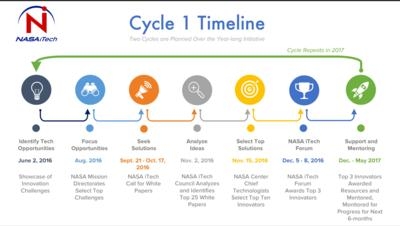
NASA's iTech initiative is a yearlong effort to find innovative ideas through a call for white papers that address challenges that will fill gaps in five critical areas identified by NASA as having a potential impact on future exploration. The technology areas are: radiation protection; life support systems in space; astronaut crew health; in-space propulsion; and the ability to achieve very high-resolution measurements of key greenhouse gases.
“NASA has programs to address the agency’s current exploration goals, but we want to also include non-traditional innovators we haven’t heard from before,” said Kira Blackwell, Innovation program executive within NASA’s Office of the Chief Technologist in Washington. “NASA’s iTech is a collaborative effort with other agencies, universities, industry and the public to help us reach mutually beneficial technology goals.”
The iTech initiative is open to U.S. citizens, universities, organizations and businesses. The call for papers opens Sept. 21 and closes Oct. 17. A panel of subject matter experts will review the papers and down-select the top 10 finalists based on their relevance and potential impact in the technology topic areas.
The top 10 finalists will be invited to present their solutions at the NASA iTech Forum at NASA Headquarters in Washington from Dec. 5-8. As part of the forum, top innovators will have the opportunity to discuss their work with industry participants and explore new technology development partnerships.
NASA iTech is an initiative by the Office of the Chief Technologist and managed by the National Institute of Aerospace (NIA) in Hampton, Virginia. NIA will assist the first cycle of NASA iTech selectees by providing six months of mentoring with the goal of developing a customized implementation plan to further move the innovation toward real-world use.
(Infographic provided with NASA news release)
More News
Its Offerings Are Lighter, Cleaner, and Now Pushing Past 1,000nm on SAF Jet Fuel DeltaHawk’s diesel-powered aircraft lineup has seen incredible upgrades over the last few yea>[...]
The Airplane Experienced A Total Loss Of Engine Power On December 3, 2025, about 1600 central standard time, a Mooney Aircraft Corp. M20K, N57229, was substantially damaged when it>[...]
Make Sure You NEVER Miss A New Story From Aero-News Network Do you ever feel like you never see posts from a certain person or page on Facebook or Instagram? Here’s how you c>[...]
Aero Linx: European Society of Aerospace Medicine (ESAM) As a pan-European, independent forum, it works to promote the safety and health of all persons involved in aviation and spa>[...]
“We are excited to see Wisk achieve this milestone, and I’m so proud of the team that made it possible. The team at Wisk has built advanced technologies across flight c>[...]



 Aero-TV: DeltaHawks Diesel Power Steps Into the Spotlight


 See All