Didn't We See This In Stars Wars IV?
 Northrop Grumman Corporation's Integrated Systems
sector achieved a significant milestone in autonomously controlled
flight Sunday with the successful first flight of its Pegasus
experimental unmanned air vehicle (UAV). The flight took place at
Naval Air Warfare Center-Weapons Division, China Lake, Calif.
Northrop Grumman Corporation's Integrated Systems
sector achieved a significant milestone in autonomously controlled
flight Sunday with the successful first flight of its Pegasus
experimental unmanned air vehicle (UAV). The flight took place at
Naval Air Warfare Center-Weapons Division, China Lake, Calif.
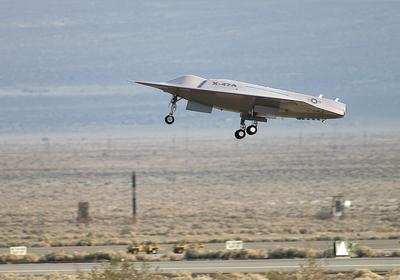
Northrop Grumman designed and built the Pegasus X-47A with its
own funds to demonstrate low-cost, rapid prototyping; robust
unmanned vehicle management; and tailless aerodynamic qualities
suitable for autonomous launch and recovery flight operations from
an aircraft carrier. Lessons learned from the development and
testing of Pegasus will be used in support of the company's naval
unmanned combat air vehicle (UCAV-N) program for the U.S. Defense
Advanced Research Projects Agency (DARPA) and the U.S. Navy.
 Sunday's flight began at 7:56 a.m. PST and lasted 12 minutes.
Specific test objectives included low-speed handling qualities, air
vehicle performance, navigation performance and collection of
landing dispersion data. All test objectives were met.
Sunday's flight began at 7:56 a.m. PST and lasted 12 minutes.
Specific test objectives included low-speed handling qualities, air
vehicle performance, navigation performance and collection of
landing dispersion data. All test objectives were met.
Most significantly, the X-47A successfully landed near a
predesignated touchdown point to simulate the tailhook arrestment
point on a carrier flight deck. This landing data, coupled with
subsequent
flight touchdown points, will demonstrate the X-47A system's
landing accuracy potential. The shipboard-relative global
positioning satellite system was used as the primary navigation
source for increased landing precision.
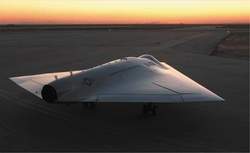
Built largely with composite materials and powered by a Pratt
& Whitney JT15D-5C engine providing 3,200 pounds of thrust,
Pegasus measures 27.9 feet long with a nearly equal wingspan of
27.8 feet. The X-47A incorporates advanced autonomous flight
control laws to account for directional control of its tailless
design.
"The Pegasus program represents our commitment to significantly
reduce the risk for our DARPA and Navy customers on the UCAV-N
program," said Gary W. Ervin, Northrop Grumman Integrated Systems
sector vice president for Air Combat Systems. "Regular unmanned
flight operations aboard a flight deck at sea have never been
attempted, and Pegasus addressed some of those key concerns
today.
 "In
addition, today's event leverages Northrop Grumman's experience
with thousands of hours of autonomous flight by unmanned systems
such as Global Hawk and Fire Scout," Ervin said. "Our approach to
design from a 'system' perspective is reflected in our success with
a full range of UAVs, and Pegasus is a logical progression in
repeatable performance with a complex aerodynamic shape. This
success also points to the potential for joint use of the Pegasus
design to meet Air Force requirements in the government's emerging
Joint UCAV program."
"In
addition, today's event leverages Northrop Grumman's experience
with thousands of hours of autonomous flight by unmanned systems
such as Global Hawk and Fire Scout," Ervin said. "Our approach to
design from a 'system' perspective is reflected in our success with
a full range of UAVs, and Pegasus is a logical progression in
repeatable performance with a complex aerodynamic shape. This
success also points to the potential for joint use of the Pegasus
design to meet Air Force requirements in the government's emerging
Joint UCAV program."
The goal of the joint DARPA/Navy UCAV-N program is to
demonstrate the technical feasibility for an unmanned system to
effectively and affordably conduct sea-based surveillance, strike
and suppression of enemy air defenses missions within the emerging
global command and control architecture. The Pegasus program will
play a significant role in supporting this effort.
The X-47A was designed in El Segundo at the Air Combat Systems
business area of Northrop Grumman Integrated Systems. The vehicle
was built at Scaled Composites in Mojave, Calif.



 ANN's Daily Aero-Term (12.19.25): Ultrahigh Frequency (UHF)


 See All