Tue, Apr 12, 2011
German And U.S. Agencies Team Up For Advanced Rotor
Research
A helicopter relies on its rotor to be able to take off and land
vertically. The rotor is also responsible for the noise a
helicopter makes during flight. Researchers at the German Aerospace
Center (Deutsches Zentrum fur Luft- und Raumfahrt; DLR) in
Gottingen and NASA are investigating the exact origin of this rotor
noise. The aim is to make the helicopters of the future
quieter.
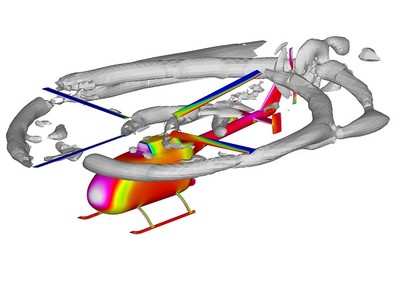
The collaboration between NASA and the DLR is the subject of a
bilateral agreement. "Our speciality at DLR Gottingen is optical
measurement technology for fluid flows," says Markus Raffel, head
of the helicopter department at the DLR site in Gottingen. NASA
scientist James T. Heineck confirms: "The team at Gottingen is
among the best in the world." NASA researchers are contributing the
most up-to-date measurement technology and their experience with
experiments in the largest wind tunnel in the world.
"Almost everything you hear from a helicopter is aerodynamic
noise. A large part of this comes from what are called rotor tip
vortices," says Raffel. Blade tip vortices occur at the outer end
of the rotor blade. "Reduced pressure on the top of the blade draws
air upwards producing a vortex. The blade tip vortex is then
directed downwards," explains DLR researcher Karen Mulleners, who
is carrying out the tests in collaboration with NASA colleagues.
"When other rotor blades subsequently come into contact with these
vortices, the 'chopping' or throbbing noise that is characteristic
of helicopters is produced."

The researchers are using a test stand with a rotor model from
RWTH Aachen for their investigations. They are using seven
high-speed cameras, lasers and high-powered LEDs to make the vortex
visible. "The special thing here is the simultaneous use of three
different optical measurement techniques," explains Raffel. The
density and the velocity fields in the vortices and the deformation
of the rotor blades are recorded. As in medicine, multiple
investigative methods help reach the correct diagnosis. Thanks to
the latest high-speed cameras, filming at speeds of up to 4000
frames per second is possible. This enables the turbulent,
constantly changing vortex to be observed continuously for the
first time. Until now, the time resolution of cameras has only been
sufficient to capture snapshots.
The rotor tip vortices are also responsible for another problem;
when they touch the ground during take-off or landing, dust or snow
can be swirled up. This can put the pilot in danger as he faces
what is known as a 'brownout' - a complete loss of orientation.
The current measurements will form the basis for future tests in
a wind tunnel. Research using a real helicopter is planned for the
future.
More News
“We respectfully call on the City of Mesa to: 1. Withdraw the landing fee proposal immediately 2. Engage with the aviation community before making decisions that impact safet>[...]
High Speed Taxiway A long radius taxiway designed and provided with lighting or marking to define the path of aircraft, traveling at high speed (up to 60 knots), from the runway ce>[...]
Aero Linx: International Federation of Airworthiness (IFA) IFA uniquely combines together all those with responsibility for policies, principles and practices concerned with the co>[...]
Controller’s Expectation That VW02 Would Have Departed Sooner Led To An Inadequate Scan And Loss Of Situational Awareness Analysis: A Robinson R-44 helicopter N744AF, VW02 (V>[...]
A Few Questions AND Answers To Help You Get MORE Out of ANN! 1) I forgot my password. How do I find it? 1) Easy... click here and give us your e-mail address--we'll send it to you >[...]



 Aero-News: Quote of the Day (12.09.25)


 See All