Yet, NASA Manager Defends Her Decision
 Seldom in the
course of history is a single, heartwrenching tragedy so solidly
linked to a precipitating moment.
Seldom in the
course of history is a single, heartwrenching tragedy so solidly
linked to a precipitating moment.
Yet, right there on audio tape, recorded during a nationwide
conference call, is the voice of Linda Ham (right), a shuttle
manager at the Johnson Space Center in Houston (TX):
"(T)he material properties and density of the foam wouldn't do
any damage," she says in a conversation with engineer Don
McCormick.
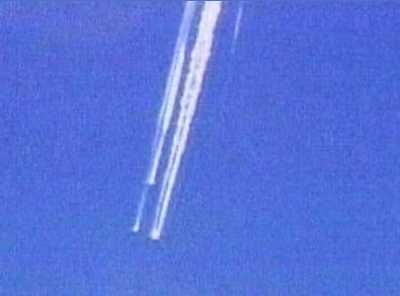
With that turn of words, Columbia was doomed, five days
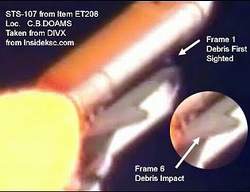
after a chunk of insulating foam from the orbiter's external fuel
tank slammed into the shuttle's left wing leading edge. That
strike, according to preliminary information from the
Columbia Accident Investigation Board, most likely allowed
superheated gasses to enter the wing structure, leading to the
shuttle's disintegration as it re-entered Earth's atmosphere.
"Really, I don't think there is much we can do," Ham said in the
January 21st conference call. "It's not really a factor during the
flight because there isn't much we can do about it."
Judgement Day
Tuesday, a tearful Linda Ham speculated for reporters in Houston
on what might have been. "We were all trying to do the right thing.
All along, we were basing our decisions on the best information
that we had at the time," she said. "Nobody wanted to do any harm
to anyone. Obviously, nobody wants to hurt the crew. These people
are our friends. They're our neighbors. We run with them, work out
in the gym with them. My husband is an astronaut. I don't believe
anyone is at fault for this."

Ham acknowledged she could have ordered American spy satellites
to take detailed photos of the possible damage to
Columbia's left wing.
But she didn't. Why?
 She says none of the
engineers who wanted the photos actually approached her for them.
On the conference call tape, Don McCormick mentions in passing a
request from other NASA and Boeing engineers for more "parametric"
data on the possible wing damage. But Ham brushed it off in the
conference call. "I really can't find the source (of the request),
so I don't think we need to pursue this."
She says none of the
engineers who wanted the photos actually approached her for them.
On the conference call tape, Don McCormick mentions in passing a
request from other NASA and Boeing engineers for more "parametric"
data on the possible wing damage. But Ham brushed it off in the
conference call. "I really can't find the source (of the request),
so I don't think we need to pursue this."
It was Ham's first public statement since the
February 1st Columbia tragedy. At one point, she choked
up, borrowing a handkerchief to wipe away her tears.
Gallantly, Ham took responsibility Tuesday for
the decision to disregard possible damage to Columbia's
wing. "We all heard the discussions," she said. "None of us felt
that the analysis (of the danger posed by the foam debris strike)
was faulty. It ended that day. It never came up again. Never. Not
in a hallway, not in the mission management team."
Had They Known...
It did come up again, but long after it was too late. The CAIB
has found that block of foam, twice the size and twice the weight
of foam debris that struck the underside of Atlantis's
wing in October, 2002, almost certainly punched a sizeable hole in
Columbia's wing. Even worse in terms of second-guessing,
CAIB Chairman Harold Gehman (Admiral, USN, ret.) contradicted
statements made on the day of the crash from then-shuttle program
manager Ron Dittemore. He told reporters there was absolutely
nothing that could have been done, even if NASA had known
there was a potentially fatal error aboard the orbiter. In May,
Gehman said Atlantis could almost certainly have been
launched in time to effect a rescue mission.
If only Ham, McCormick, Dittemore and others on that conference
call had known then, what they know now...



 ANN's Daily Aero-Term (12.19.25): Ultrahigh Frequency (UHF)


 See All