
NASA Rates Perseid Meteor Shower 'Best For Fireballs' | Aero-News Network
Aero-News Network
RSS icon RSS feed
podcast icon MP3 podcast
Subscribe Aero-News e-mail Newsletter Subscribe

Airborne Unlimited -- Most Recent Daily Episodes

Episode Date

Airborne-Monday

Airborne-Tuesday

Airborne-Wednesday Airborne-Thursday

Airborne-Friday

Airborne On YouTube

Airborne-Unlimited-12.08.25

AirborneNextGen-
12.09.25

Airborne-Unlimited-12.10.25

Airborne-AffordableFlyers-12.11.25

AirborneUnlimited-12.05.25

AFE 2025 LIVE MOSAIC Town Hall (Archived): www.airborne-live.net

Mon, Aug 12, 2013

NASA Rates Perseid Meteor Shower 'Best For Fireballs'

Mid-August Event Made Possible By Comet Swift-Tuttle

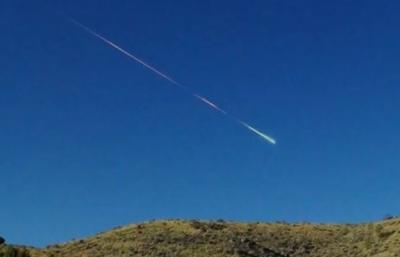
In astronomy, there's nothing quite like a bright meteor streaking across the glittering canopy of a moonless night sky.  The unexpected flash of light adds a dash of magic to an ordinary walk under the stars.

New research by NASA has just identified the most magical nights of all.

"We have found that one meteor shower produces more fireballs than any other," explains Bill Cooke of NASA's Meteoroid Environment Office.  "It's the Perseid meteor shower, which peaks on August 12th and 13th."

Using a network of meteor cameras distributed across the southern USA, Cooke's team has been tracking fireball activity since 2008, and they have built up a database of hundreds of events to analyze. The data point to the Perseids as the 'fireball champion' of annual meteor showers. A fireball is a very bright meteor, at least as bright as the planets Jupiter or Venus.  They can be seen on any given night as random meteoroids strike Earth's upper atmosphere. One fireball every few hours is not unusual.  Fireballs become more numerous, however, when Earth is passing through the debris stream of a comet.  That’s what will happen this August.

The Perseid meteor shower comes from Comet Swift-Tuttle.  Every year in early- to mid-August, Earth passes through a cloud of dust sputtered off the comet as it approaches the sun.  Perseid meteoroids hitting our atmosphere at 132,000 mph produce an annual light show that is a favorite of many backyard sky watchers.

Cooke thinks the Perseids are rich in fireballs because of the size of the parent comet. "Comet Swift-Tuttle has a huge nucleus--about 26 km in diameter," comments Cooke. "Most other comets are much smaller, with nuclei only a few kilometers across. As a result, Comet Swift-Tuttle produces a large number of meteoroids, many of which are large enough to produce fireballs."

Cooke recommends looking on the nights of August 12th and 13th between the hours of 10:30 PM to 4:30 AM local time. Before midnight the meteor rate will start out low, then increase as the night wears on, peaking before sunrise when the constellation Perseus is high in the sky. For every fireball that streaks out of Perseus, there will be dozens more ordinary meteors.

"Get away from city lights," advises Cooke.  "While fireballs can be seen from urban areas, the much greater number of faint Perseids is visible only from the countryside."

In total, the Perseid meteor rate from dark-sky sites could top 100 per hour.

(Image provided by NASA)

FMI: www.nasa.gov

Advertisement

More News

Aero-News: Quote of the Day (12.09.25)

“We respectfully call on the City of Mesa to: 1. Withdraw the landing fee proposal immediately 2. Engage with the aviation community before making decisions that impact safet>[...]

ANN's Daily Aero-Term (12.09.25): High Speed Taxiway

High Speed Taxiway A long radius taxiway designed and provided with lighting or marking to define the path of aircraft, traveling at high speed (up to 60 knots), from the runway ce>[...]

ANN's Daily Aero-Linx (12.09.25)

Aero Linx: International Federation of Airworthiness (IFA) IFA uniquely combines together all those with responsibility for policies, principles and practices concerned with the co>[...]

NTSB Final Report: Diamond Aircraft Ind Inc DA20C1 (A1); Robinson Helicopter R44

Controller’s Expectation That VW02 Would Have Departed Sooner Led To An Inadequate Scan And Loss Of Situational Awareness Analysis: A Robinson R-44 helicopter N744AF, VW02 (V>[...]

ANN FAQ: Q&A 101

A Few Questions AND Answers To Help You Get MORE Out of ANN! 1) I forgot my password. How do I find it? 1) Easy... click here and give us your e-mail address--we'll send it to you >[...]

blog comments powered by Disqus



Advertisement

Advertisement

Podcasts

Advertisement

© 2007 - 2025 Web Development & Design by Pauli Systems, LC

