

NTSB Issues Prelim On DC-4 Runway Incident In Alaska | Aero-News Network
Aero-News Network
RSS icon RSS feed
podcast icon MP3 podcast
Subscribe Aero-News e-mail Newsletter Subscribe

Airborne Unlimited -- Most Recent Daily Episodes

Episode Date

Airborne-Monday

Airborne-Tuesday

Airborne-Wednesday Airborne-Thursday

Airborne-Friday

Airborne On YouTube

Airborne-Unlimited-12.01.25

AirborneNextGen-
12.02.25

Airborne-Unlimited-12.03.25

Airborne-AffordableFlyers-11.20.25

AirborneUnlimited-11.21.25

LIVE MOSAIC Town Hall (Archived): www.airborne-live.net

Mon, Jun 04, 2007

NTSB Issues Prelim On DC-4 Runway Incident In Alaska

Pilot Says Plane Hit Thermal, Became Low on Landing Approach

The NTSB has issued a preliminary report on the May 30 incident involving a rare DC-4 in McGrath, AK.

According to the report, the wheel-equipped Douglas DC-4, modified as a Carvair ATL-98, sustained substantial damage when it collided with the approach end of a remote mine site runway at the Nixon Fork Mine Airport during the landing flare/touchdown, about 28 miles northeast of McGrath, AK.

According to the captain, the airplane encountered sinking air and became low on the landing approach, and the right main landing gear struck the lip of the gravel-surface 4,200-foot runway, about 1,510 msl.

The right main landing gear was torn off, which allowed the nose and right wing to collide with the runway surface. The right wing was torn off the fuselage, caught fire, and continued to burn for 1½ hours. The fuselage, containing the cargo of fuel bladders, slid to a stop, rotating about 90 degrees to the left.

The airplane, operated by Brooks Air Transport, dba Brooks Fuel, Inc., Fairbanks, AK, was being operated as a VFR cross-country non-scheduled cargo flight under Title 14, CFR Part 125, when the accident occurred.

The captain, an airline transport certificated pilot, and the first officer, a commercial certificated pilot, were uninjured.

Visual meteorological conditions prevailed, and VFR company flight following procedures were in effect. The flight originated at the Fairbanks International Airport about 10:30 am and the accident occurred at about noon.

The pilot indicated that the weather conditions consisted of an east wind of about 5 to 10 knots, and mostly clear skies, with isolated areas of convective cloud formations.

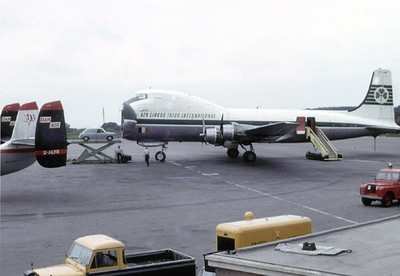
Akin in appearance to a shrunken, propeller-equipped 747, the Carvair (shown below) was built off the fuselage of a DC-4 but modified with more powerful engines, a larger vertical stabilizer, and a nose-mounted, swingaway cargo door -- part of an eight-foot extension to the plane's nose. To clear the door, the plane's cockpit was raised above the fuselage, giving the aircraft its humpbacked appearance. A prototype aircraft first flew in 1961; only 21 frames were produced by Aviation Traders Ltd.

The aircraft that crashed last week was one of only two flying Carvairs still remaining. The plane is likely a total loss.

FMI: www.ntsb.gov, www.oldwings.nl/content/n898at/n898at.htm

Advertisement

More News

ANN's Daily Aero-Term (12.01.25): Convective SIGMET

Convective SIGMET A weather advisory concerning convective weather significant to the safety of all aircraft. Convective SIGMETs are issued for tornadoes, lines of thunderstorms, e>[...]

ANN's Daily Aero-Linx (12.01.25)

Aero Linx: United Flying Octogenarians WELCOME to a most extraordinary group of aviators, the United Flying Octogenarians (UFO). Founded in 1982 with just a handful of pilots, we h>[...]

NTSB Final Report: Remos Aircraft GmbH Remos GX

Pilot’s Decision To Attempt Takeoff With Frost Covering The Airplane’s Wings Analysis: The pilot of the light sport airplane was preparing to depart for a cross-country>[...]

Aero-News: Quote of the Day (12.02.25)

“We’ve paid for the cable line’s repair for the customer and have apologized for the inconvenience this caused them...” Source: Some followup info from an A>[...]

ANN's Daily Aero-Term (12.02.25): Coupled Approach

Coupled Approach An instrument approach performed by the aircraft autopilot, and/or visually depicted on the flight director, which is receiving position information and/or steerin>[...]

blog comments powered by Disqus



Advertisement

Advertisement

Podcasts

Advertisement

© 2007 - 2025 Web Development & Design by Pauli Systems, LC

