
Gone West: Korean War-Era Pilot Kenneth Schechter | Aero-News Network
Aero-News Network
RSS icon RSS feed
podcast icon MP3 podcast
Subscribe Aero-News e-mail Newsletter Subscribe

Airborne Unlimited -- Most Recent Daily Episodes

Episode Date

Airborne-Monday

Airborne-Tuesday

Airborne-Wednesday Airborne-Thursday

Airborne-Friday

Airborne On YouTube

Airborne-Unlimited-12.08.25

AirborneNextGen-
12.02.25

Airborne-Unlimited-12.03.25

Airborne-FltTraining-12.04.25

AirborneUnlimited-12.05.25

AFE 2025 LIVE MOSAIC Town Hall (Archived): www.airborne-live.net

Wed, Dec 25, 2013

Gone West: Korean War-Era Pilot Kenneth Schechter

Landed His Airplane After Being Blinded By Enemy Fire

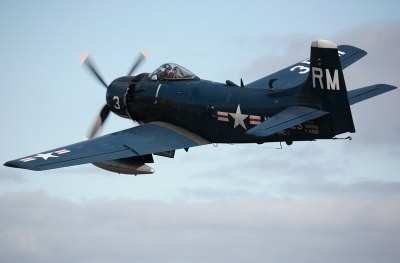
His Skyraider had been hit. Fragments of the airplane had pierced his eyes. And somehow, Navy pilot Ensign Kenneth Schechter managed to land his crippled airplane at a remote Army dirt strip in Korea, guided by his best friend on the USS Valley Forge; Lt. j.g. Howard Thayer.

Schechter lost his right eye, but lived until December 11th, when he passed away from prostate cancer at the age of 83.

The Los Angeles Times reports that Schechter's plane was hit during a mission to bomb rail and truck lines on his 27th combat sortie over Korea. He recalled in a 1995 interview that he poured his canteen over his head in an effort to wash the blood from his face. He said he briefly saw his instrument panel through a red haze, and then nothing.

Thayer said that during the return flight, he saw Schechter struggling to remain conscious and control his plane. Searching desperately for any place to land that didn't involve bailing out over the ocean, he remembered a rutted airstrip called "Jersey Bounce" that had been used by recon aircraft. Flying just feet from the stricken Skyraider, he guided his friend to the strip. When Thayer told Schechter to put his wheels down, the injured pilot reportedly said "to hell with that," adding that a gear-up landing would probably be more survivable on the rough airstrip.

He was right, and he did survive. Schechter eventually earned a bachelor’s degree from Stanford and a Master's degree from Harvard Business School.

Schechter was awarded the Distinguished Flying Cross in the mid-1960s, but it took intervention from his Congressman to have the medal presented. The Navy had never received the proper paperwork for the commendation.

Thayer died in 1961, again attempting to help a fellow pilot. He was guiding another airplane which had suffered an electrical system failure when both went down in the Mediterranean. Neither Thayer nor the other pilot was ever recovered. Thayer was posthumously awarded the Distinguished Flying Cross in 2009.

(Skyraider image from file)

FMI: www.navy.mil

Advertisement

More News

NTSB Final Report: Patriot Aircraft LLC CX1900A

After Draining Both Wing Fuel Tanks, A Significant Amount Of Water Was Observed In The Right Wing Fuel Tank Analysis: The pilot, who was also the owner of the experimental amateur->[...]

Aero-News: Quote of the Day (12.06.25)

“Airbus apologises for any challenges and delays caused to passengers and airlines by this event. The Company thanks its customers, the authorities, its employees and all rel>[...]

ANN's Daily Aero-Term (12.06.25): High Speed Taxiway

High Speed Taxiway A long radius taxiway designed and provided with lighting or marking to define the path of aircraft, traveling at high speed (up to 60 knots), from the runway ce>[...]

ANN's Daily Aero-Linx (12.06.25)

Aero Linx: Taylorcraft Foundation, Inc. The Taylorcraft Foundation is exclusively organized for charitable, educational & scientific activities and will preserve the history an>[...]

Airborne-NextGen 12.02.25: Honda eVTOL, Arctus High-Alt UAS, Samson Patent

Also: USAF Reaper Accident, Baikonur Damage, Horizon eVTOL IFR/FIKI, New Glenn Update Honda has outlined its clearest timeline yet for its entry into the world of electric vertical>[...]

blog comments powered by Disqus



Advertisement

Advertisement

Podcasts

Advertisement

© 2007 - 2025 Web Development & Design by Pauli Systems, LC

