
NASA's Juno Spacecraft Completes Flyby Over Jupiter's Great Red Spot | Aero-News Network
Aero-News Network
RSS icon RSS feed
podcast icon MP3 podcast
Subscribe Aero-News e-mail Newsletter Subscribe

Airborne Unlimited -- Most Recent Daily Episodes

Episode Date

Airborne-Monday

Airborne-Tuesday

Airborne-Wednesday Airborne-Thursday

Airborne-Friday

Airborne On YouTube

Airborne-Unlimited-12.08.25

AirborneNextGen-
12.09.25

Airborne-Unlimited-12.10.25

Airborne-AffordableFlyers-12.11.25

AirborneUnlimited-12.12.25

AFE 2025 LIVE MOSAIC Town Hall (Archived): www.airborne-live.net

Thu, Jul 13, 2017

NASA's Juno Spacecraft Completes Flyby Over Jupiter's Great Red Spot

Next Flyby Will Occur September First

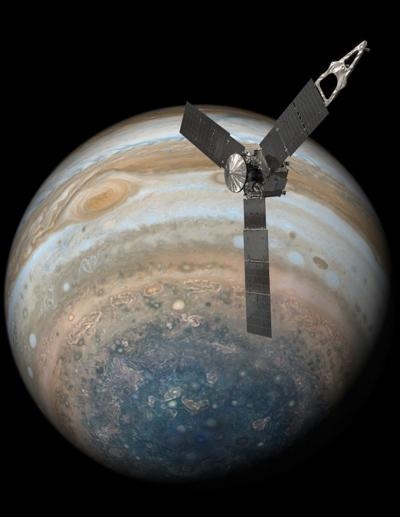
NASA's Juno mission completed a close flyby of Jupiter and its Great Red Spot on July 10, during its sixth science orbit. All of Juno's science instruments and the spacecraft's JunoCam were operating during the flyby, collecting data that are now being returned to Earth. Juno's next close flyby of Jupiter will occur on Sept. 1. Raw images from the spacecraft’s latest flyby will be posted in coming days.

"For generations people from all over the world and all walks of life have marveled over the Great Red Spot," said Scott Bolton, principal investigator of Juno from the Southwest Research Institute in San Antonio. "Now we are finally going to see what this storm looks like up close and personal."

The Great Red Spot is a 10,000-mile-wide storm that has been monitored since 1830 and has possibly existed for more than 350 years. In modern times, the Great Red Spot has appeared to be shrinking.

Juno reached perijove (the point at which an orbit comes closest to Jupiter's center) on July 10 at 6:55 p.m. PDT (9:55 p.m. EDT). At the time of perijove, Juno was about 2,200 miles above the planet's cloud tops. Eleven minutes and 33 seconds later, Juno had covered another 24,713 miles (39,771 kilometers), and was passing directly above the coiling crimson cloud tops of the Great Red Spot. The spacecraft passed about 5,600 miles above the clouds of this iconic feature.

On July 4 at 7:30 p.m. PDT (10:30 p.m. EDT), Juno logged exactly one year in Jupiter orbit, marking 71 million miles of travel around the giant planet.

Juno launched on Aug. 5, 2011, from Cape Canaveral, Florida. During its mission of exploration, Juno soars low over the planet's cloud tops -- as close as about 2,100 miles. During these flybys, Juno is probing beneath the obscuring cloud cover of Jupiter and studying its auroras to learn more about the planet's origins, structure, atmosphere and magnetosphere.

Early science results from NASA's Juno mission portray the largest planet in our solar system as a turbulent world, with an intriguingly complex interior structure, energetic polar aurora, and huge polar cyclones.

(Image provided with NASA news release)

FMI: www.nasa.gov

Advertisement

More News

ANN FAQ: Contributing To Aero-TV

How To Get A Story On Aero-TV News/Feature Programming How do I submit a story idea or lead to Aero-TV? If you would like to submit a story idea or lead, please contact Jim Campbel>[...]

Aero-News: Quote of the Day (12.10.25)

“As the excitement builds for the world of flight returning to Oshkosh in 2026, we wanted to ensure that advance tickets are available for those who enjoy giving AirVenture t>[...]

ANN's Daily Aero-Term (12.10.25): North Atlantic High Level Airspace (NAT HLA)

North Atlantic High Level Airspace (NAT HLA) That volume of airspace (as defined in ICAO Document 7030) between FL 285 and FL 420 within the Oceanic Control Areas of Bodo Oceanic, >[...]

Airborne 12.08.25: Samaritan’s Purse Hijack, FAA Med Relief, China Rocket Fail

Also: Cosmonaut Kicked Out, Airbus Scales Back, AF Silver Star, Russian A-60 Clobbered A Samaritan’s Purse humanitarian flight was hijacked on Tuesday, December 2, while atte>[...]

Airborne-Flight Training 12.04.25: Ldg Fee Danger, Av Mental Health, PC-7 MKX

Also: IAE Acquires Diamond Trainers, Army Drones, FedEx Pilots Warning, DA62 MPP To Dresden Tech Uni The danger to the flight training industry and our future pilots is clear. Dona>[...]

blog comments powered by Disqus



Advertisement

Advertisement

Podcasts

Advertisement

© 2007 - 2025 Web Development & Design by Pauli Systems, LC

