
Wed, Feb 28, 2024
Flying Car Revisions Focusing on Easier Production, Increased Payload
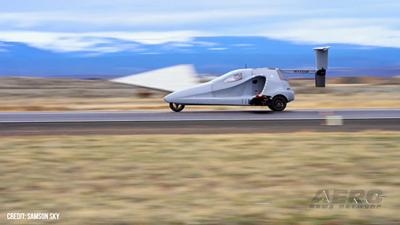
The team behind the Switchblade 'flying car' has updated their fanbase on the aircraft's current state, describing their recent issues, challenges, and desires for the program.

The most recent news pertains primarily to polishing certain aspects of the design, less than a year after they first completed a successful test flight. With many of their bases covered, Switchblade staff are looking to decrease production costs through refinement of existing processes and procedures, and snagging whatever performance improvements they can in the process. The team reported that the aircraft flies well, noting that all its "aerodynamics, flying qualities, slow speed handling, take off characteristics, and landing ease were just what we had hoped for." They know that customers will always demand greater payload, faster speed, and longer range, so those will be next up in the development process.
Thrust and drag improvements to the ducted fan propulsion system will hopefully provide a little boost to top-end speed and performance, and a larger wing should provide a lower approach speed with increased useful load. The team is mulling over wing refinements that would not only "reduce maintenance and assembly times, but also provide for better performance and lighter weight." They acknowledge that "We are not done by any stretch of the imagination, but we are very well along with the production design and will be going back to the wind tunnel soon to validate our proposed changes." Changes to the tail section and elevator may be in the cards, too, helping to polish off the Switchblade's top-end performance and some high-speed bragging rights.
Specifics haven't been published just yet, since they may end up a part of the Switchblade patent collection. If possible, they would like to get the Switchblade closer to Part 23 standards for landing speeds, making it somewhere around 61 knots. Secondarily to the speed change is the aim to "increase useful load to over 650 lbs. We are looking to increase the maximum fuel load to be 44 gallons (up from 33 gallons earlier)."
More News
Convective SIGMET A weather advisory concerning convective weather significant to the safety of all aircraft. Convective SIGMETs are issued for tornadoes, lines of thunderstorms, e>[...]
Aero Linx: United Flying Octogenarians WELCOME to a most extraordinary group of aviators, the United Flying Octogenarians (UFO). Founded in 1982 with just a handful of pilots, we h>[...]
Pilot’s Decision To Attempt Takeoff With Frost Covering The Airplane’s Wings Analysis: The pilot of the light sport airplane was preparing to depart for a cross-country>[...]
“We’ve paid for the cable line’s repair for the customer and have apologized for the inconvenience this caused them...” Source: Some followup info from an A>[...]
Coupled Approach An instrument approach performed by the aircraft autopilot, and/or visually depicted on the flight director, which is receiving position information and/or steerin>[...]


