
Parker Solar Probe Makes History With Closest Pass | Aero-News Network
Aero-News Network
RSS icon RSS feed
podcast icon MP3 podcast
Subscribe Aero-News e-mail Newsletter Subscribe

Airborne Unlimited -- Most Recent Daily Episodes

Episode Date

Airborne-Monday

Airborne-Tuesday

Airborne-Wednesday Airborne-Thursday

Airborne-Friday

Airborne On YouTube

Airborne-Unlimited-11.24.25

AirborneNextGen-
11.18.25

Airborne-Unlimited-11.19.25

Airborne-AffordableFlyers-11.20.25

AirborneUnlimited-11.21.25

LIVE MOSAIC Town Hall (Archived): www.airborne-live.net

Wed, Jan 01, 2025

Parker Solar Probe Makes History With Closest Pass

Ops Teams Confirmed NASA Mission “Touched The Sun”

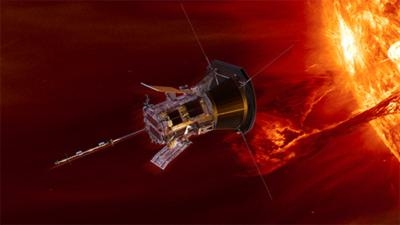
NASA’s Parker Solar Probe came within 3.8 million miles of the Sun on December 24 and survived, operations teams have confirmed.

The closest approach flyby occurred at 6:53 a.m. EST while the spacecraft was cruising at a blistering 430,000 mph.

There was no lack of drama, however, as the spacecraft did not send any messages until the night of December 26 when mission specialists were crowded around a control room waiting to hear from Parker.

The expected signals actually arrived a few seconds early.

Dr. Nour Rawafi, an astrophysicist at Johns Hopkins Applied Physics Laboratory and the project scientist for the mission, said, “I’m proud of what has been achieved. It’s really a historic milestone for space exploration.”

The Parker probe utilized a series of gravity-assist maneuvers, swinging around Venus seven times to set up for the close solar flybys by transitioning into a very eccentric orbit that brought it closer and closer to the optimal orbit.

Dr. Rawafi continued, “Parker Solar Probe is braving one of the most extreme environments in space and exceeding all expectations. This mission is ushering a new golden era of space exploration, bringing us closer than ever to unlocking the Sun’s deepest and most enduring mysteries.”

Nicky Fox, who leads the Science Mission Directorate at NASA Headquarters in Washington said, "Flying this close to the Sun is a historic moment in humanity’s first mission to a star. By studying the Sun up close, we can better understand its impacts throughout our solar system, including on the technology we use daily on Earth and in space, as well as learn about the workings of stars across the universe to aid in our search for habitable worlds beyond our home planet.”

FMI:  science.nasa.gov/

Advertisement

More News

ANN's Daily Aero-Term (11.28.25): Unmanned Aircraft System (UAS)

Unmanned Aircraft System (UAS) An unmanned aircraft and its associated elements related to safe operations, which may include control stations (ground, ship, or air based), control>[...]

ANN's Daily Aero-Linx (11.28.25)

Aero Linx: Cactus Fly-In The Classic Airplane Association of Arizona, Inc. (CAAA) was incorporated in Arizona as a not for profit corporation on January 10, 2014. The CAAA roster i>[...]

Airborne 11.21.25: NTSB on UPS Accident, Shutdown Protections, Enstrom Update

Also: UFC Buys Tecnams, Emirates B777-9 Buy, Allegiant Pickets, F-22 And MQ-20 The NTSB's preliminary report on the UPS Flight 2976 crash has focused on the left engine pylon's sep>[...]

Airborne 11.26.25: Bonanza-Baron Fini, Archer v LA NIMBYs, Gogo Loses$$$

Also: Bell 505 on SAF, NYPA Gets Flak For BizAv 'Abuse', FAA Venezuela Caution, Horizon Update Textron Aviation has confirmed it will be ending production of the Beechcraft Bonanza>[...]

Airborne-NextGen 11.25.25: EHang Manned Flt, Army UAVs, Starship V3 Booster Boom

Also: FedEx SAF, Archer Midnight Powertrain Tech, Rocket Lab Record, Perseverance Rover Find EHang has logged a major milestone in the development of its pilotless air taxi, loggin>[...]

blog comments powered by Disqus



Advertisement

Advertisement

Podcasts

Advertisement

© 2007 - 2025 Web Development & Design by Pauli Systems, LC

