"We Are The Unheard Giant"
A diverse group of soldiers at Camp Taji, Iraq, helps to ensure
aviation crews always are ready to conduct show-of-force,
reconnaissance and presence patrols throughout Multinational
Division Center.
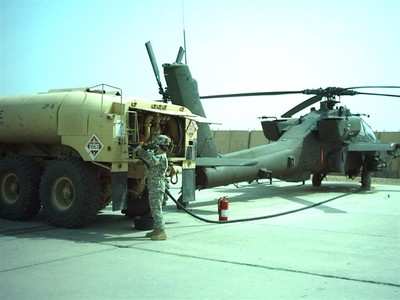
Soldiers of the distribution platoon with 1st Attack
Reconnaissance Battalion, 4th Aviation Regiment, are responsible
for the battalion's fuel, water and ammunition. The platoon is made
up of petroleum supply and ammunition specialists and truck
drivers, all critical to battalion operations.
"We are the unheard giant," platoon leader Army 2nd. Lt. James
A. Barnett said. "Our helicopters fly missions every day to help
keep guys on the ground safe; we help keep our air crews safe and
operational by providing them with fuel and ammunition."
The soldiers have pumped more than 830,000 gallons of fuel worth
$1.76 million, have managed 48 Hellfire missiles valued at $16.8
million, and have delivered more than 233 pallets of water, valued
at $1.5 million, in the eight months they have been in the combat
theater.
"The aircrews do not have the time to think about loading
ammunition and fuel, or the effort it takes to arm the helicopter
with missiles and get the helicopter where it needs to be, Barnett
said. "Our goal is to help them be fully functional."
Aviation operations are constant, and the distribution platoon
operates 24 hours a day. Generally, the soldiers work 12-hour
shifts, ensuring the AH-64D Apache helicopters have fuel and
ammunition and the battalion has water and chow.
The platoon's aviation fuelers pump about 300 gallons of cold
gas per aircraft. Cold gas is pumped after pilots have completed a
mission and the aircraft is shut down.
The fuelers also are capable of setting up a forward arming and
refueling point and conducting hot-refueling missions, in which the
helicopter lands while remaining powered up, gets refueled and is
back in the air within minutes.
Though they normally have a static set-up to pump cold gas, the
fuelers have the capability to be mobile, which offers aviation
units flexibility.
"We can set up where the aircraft need us, to reach out and
touch them," said Sgt. Michael T. Square, a petroleum supply
specialist. "Without fuel, helicopters cannot fly – they turn
into expensive paperweights."
The Apache's primary mission is to conduct rear, close and
shaping missions as well as distribution operations, precision
strikes against relocatable targets and providing armed
reconnaissance when required.
"In the eight months we have been here, we have had no failed
missions," said Army Sgt. Johnathen D. Morgan, an ammunition
specialist. Every helicopter has received its ammunition, and there
has been good accountability."
The platoon's soldiers focus on cross-training, because they are
called upon to do many different missions.
"We never know when one of our soldiers could be tasked to set
up a [forward arming and refueling point], work at a different
forward operating base, etc.," Barnett said. "My guys still have to
be able to meet mission requirements here, because the battalion
cannot conduct operations without fuel and ammunition."
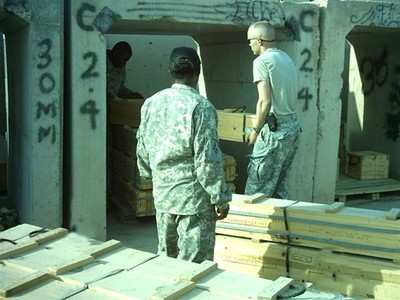
The ammunition specialists and fuelers are not the only ones who
have to cross-train; the platoon's truck drivers also have learned
how to refuel an aircraft.
"I have enjoyed learning something different," said Army Staff
Sgt. Phillip L. Parker, a truck driver who is primarily responsible
for picking up and delivering water and chow. "Learning new skills
makes my job unique, and it gives us an opportunity for a little
friendly competition to see how much fuel we can pump compared to
the fuelers."
(Aero-News salutes Army Capt. Katherine O. Zyla, with Task
Force 449.)



 ANN's Daily Aero-Linx (12.12.25)


 See All