
Astronaut Pettit, Cosmonauts Return From ISS Mission | Aero-News Network
Aero-News Network
RSS icon RSS feed
podcast icon MP3 podcast
Subscribe Aero-News e-mail Newsletter Subscribe

Airborne Unlimited -- Most Recent Daily Episodes

Episode Date

Airborne-Monday

Airborne-Tuesday

Airborne-Wednesday Airborne-Thursday

Airborne-Friday

Airborne On YouTube

Airborne-SpecialEpisode-12.15.25

AirborneNextGen-
12.16.25

Airborne-Unlimited-12.10.25

Airborne-AffordableFlyers-12.11.25

AirborneUnlimited-12.12.25

AFE 2025 LIVE MOSAIC Town Hall (Archived): www.airborne-live.net

Tue, Apr 22, 2025

Astronaut Pettit, Cosmonauts Return From ISS Mission

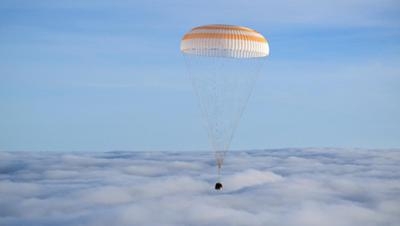
Soyuz MS-26 Spacecraft’s Parachute Landing Ends 220 Days In Space

NASA astronaut Don Pettit and Roscosmos cosmonauts Alexey Ovchinin And Ivan Vagner are safely back on terra firma after 220 days in space aboard the International Space Station where Pettit conducted numerous research tasks associated with in-orbit 3-D metal printing, water sanitation technologies, plant growth, and fire behavior in microgravity.

Oh, and Pettit also celebrated his 70th birthday upon landing in Dzhezkazgan, Kazakhstan. During the mission, officially designated Expedition 71 and 72, Pettit and crewmates completed 3,520 orbits of Earth, traveling about 93.3 million miles, just about the same distance as the Earth is from the Sun.

This was Pettit’s fourth spaceflight, where he served as the flight engineer on this mission. He has logged a total 590 days in orbit during his career. Ovchinin also completed his fourth flight for a total of 595 days, and this was Vagner’s second spaceflight for a totalof 416 days in space.

Right now, NASA is completing its routine post-landing medical checks of the crew. The crew will then return to the recovery staging area in Karaganda, Kazakhstan. There, Pettit will fly aboard a NASA flight to its Johnson Space Center in Houston, Texas. Immediate news from the landing area is that Pettit is doing well and is within the range of results expected following a mission and return to Earth.

During his time aboard the station, Pettit also demonstrated his creative side by using his camera to conduct “science of opportunity” by combining art, science, and microgravity. One of his composite images showed what happens when he used charged water droplets and a knitting needle made of Teflon to demonstrate something like the interaction of charged particles from the sun and the Earth’s atmosphere similar to the aurora or Northern Lights.

FMI:  www.nasa.gov/

Advertisement

More News

ANN's Daily Aero-Term (12.19.25): Ultrahigh Frequency (UHF)

Ultrahigh Frequency (UHF) The frequency band between 300 and 3,000 MHz. The bank of radio frequencies used for military air/ground voice communications. In some instances this may >[...]

NTSB Prelim: Cirrus Design Corp SR22T

During The 7 Second Descent, There Was Another TAWS Alert At Which Time The Engine Remained At Full Power On October 24, 2025 at 2115 mountain daylight time, a Cirrus SR22T, N740TS>[...]

Classic Aero-TV: The Red Tail Project--Carrying the Torch of the Tuskegee Airmen

From 2009 (YouTube Edition): Educational Organization Aims to Inspire by Sharing Tuskegee Story Founding leader Don Hinz summarized the Red Tail Project’s mission in simple, >[...]

Aero-News: Quote of the Day (12.19.25)

“This feels like an important step since space travel for people with disabilities is still in its very early days... I’m so thankful and hope it inspires a change in m>[...]

Airborne 12.17.25: Skydiver Hooks Tail, Cooper Rotax Mount, NTSB v NDAA

Also: New Katanas, Kern County FD Training, IndiGo’s Botched Roster, MGen. Leavitt Named ERAU Dean The Australian Transportation Safety Bureau (ATSB) has wrapped up its inves>[...]

blog comments powered by Disqus



Advertisement

Advertisement

Podcasts

Advertisement

© 2007 - 2025 Web Development & Design by Pauli Systems, LC

