
NASA Conducts Orion Parachute Testing For Orbital Test Flight | Aero-News Network
Aero-News Network
RSS icon RSS feed
podcast icon MP3 podcast
Subscribe Aero-News e-mail Newsletter Subscribe

Airborne Unlimited -- Most Recent Daily Episodes

Episode Date

Airborne-Monday

Airborne-Tuesday

Airborne-Wednesday Airborne-Thursday

Airborne-Friday

Airborne On YouTube

Airborne-SpecialEpisode-12.15.25

AirborneNextGen-
12.16.25

Airborne-Unlimited-12.10.25

Airborne-AffordableFlyers-12.11.25

AirborneUnlimited-12.12.25

AFE 2025 LIVE MOSAIC Town Hall (Archived): www.airborne-live.net

Thu, Dec 22, 2011

NASA Conducts Orion Parachute Testing For Orbital Test Flight

Test Vehicle Dropped From A C-130 At 25,000 Feet

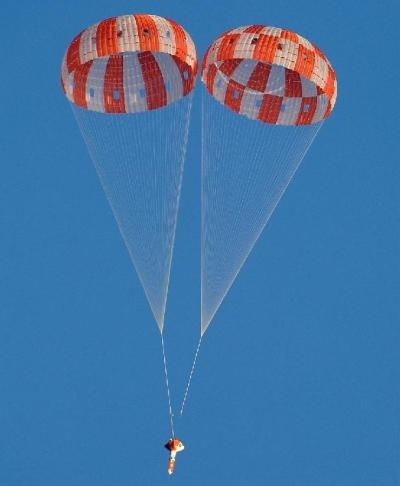
NASA successfully conducted a drop test of the Orion crew vehicle's parachutes high above the Arizona desert Tuesday in preparation for its orbital flight test in 2014. Orion will carry astronauts deeper into space than ever before, provide emergency abort capability, sustain the crew during space travel and ensure a safe re-entry and landing.

A C-130 plane dropped the Orion test article from an altitude of 25,000 feet above the U.S. Army's Yuma Proving Grounds. Orion's drogue chutes were deployed between 15,000 and 20,000 feet, followed by the pilot parachutes, which then deployed two main landing parachutes. This particular drop test examined how Orion would land under two possible failure scenarios.

Orion's parachutes are designed to open in stages, which is called reefing, to manage the stresses on the parachutes after they are deployed. The reefing stages allow the parachutes to sequentially open, first at 54 percent of the parachutes' full diameter, and then at 73 percent. This test examined how the parachutes would perform if the second part of the sequence was skipped.

The second scenario was a failure to deploy one of Orion's three main parachutes, requiring the spacecraft to land with only two. Orion landed on the desert floor at a speed of almost 33 feet per second, which is the maximum designed touchdown speed of the spacecraft. Since 2007, the Orion program has conducted a vigorous parachute air and ground test program and provided the chutes for NASA's successful pad abort test in 2010. Lessons learned from this experience have improved Orion's parachute system. (Image provided by NASA)

FMI: www.nasa.gov

Advertisement

More News

ANN's Daily Aero-Term (12.19.25): Ultrahigh Frequency (UHF)

Ultrahigh Frequency (UHF) The frequency band between 300 and 3,000 MHz. The bank of radio frequencies used for military air/ground voice communications. In some instances this may >[...]

NTSB Prelim: Cirrus Design Corp SR22T

During The 7 Second Descent, There Was Another TAWS Alert At Which Time The Engine Remained At Full Power On October 24, 2025 at 2115 mountain daylight time, a Cirrus SR22T, N740TS>[...]

Classic Aero-TV: The Red Tail Project--Carrying the Torch of the Tuskegee Airmen

From 2009 (YouTube Edition): Educational Organization Aims to Inspire by Sharing Tuskegee Story Founding leader Don Hinz summarized the Red Tail Project’s mission in simple, >[...]

Aero-News: Quote of the Day (12.19.25)

“This feels like an important step since space travel for people with disabilities is still in its very early days... I’m so thankful and hope it inspires a change in m>[...]

Airborne 12.17.25: Skydiver Hooks Tail, Cooper Rotax Mount, NTSB v NDAA

Also: New Katanas, Kern County FD Training, IndiGo’s Botched Roster, MGen. Leavitt Named ERAU Dean The Australian Transportation Safety Bureau (ATSB) has wrapped up its inves>[...]

blog comments powered by Disqus



Advertisement

Advertisement

Podcasts

Advertisement

© 2007 - 2025 Web Development & Design by Pauli Systems, LC

