
NASA, MIT, DARPA Host Fifth Annual Student Robotics Challenge Jan. 17 | Aero-News Network
Aero-News Network
RSS icon RSS feed
podcast icon MP3 podcast
Subscribe Aero-News e-mail Newsletter Subscribe

Airborne Unlimited -- Most Recent Daily Episodes

Episode Date

Airborne-Monday

Airborne-Tuesday

Airborne-Wednesday Airborne-Thursday

Airborne-Friday

Airborne On YouTube

Airborne-SpecialEpisode-12.15.25

AirborneNextGen-
12.16.25

Airborne-Unlimited-12.10.25

Airborne-AffordableFlyers-12.11.25

AirborneUnlimited-12.12.25

AFE 2025 LIVE MOSAIC Town Hall (Archived): www.airborne-live.net

Sat, Jan 18, 2014

NASA, MIT, DARPA Host Fifth Annual Student Robotics Challenge Jan. 17

Software Developed By High School Students To Be Uploaded To ISS

NASA participated in the fifth annual Zero Robotics SPHERES Challenge Friday, Jan. 17, at the Massachusetts Institute of Technology (MIT) campus in Cambridge, MA. The agency joined in the event with the Defense Advanced Research Projects Agency, MIT, the European Space Agency, the Center for the Advancement of Science in Space, IT consulting firm Appirio, and high school student teams from the United States and abroad.

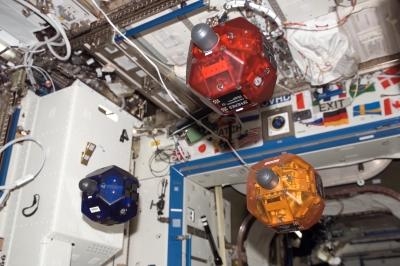
For the competition, NASA uploaded software developed by high school students onto bowling ball-sized spherical satellites called Synchronized Position Hold, Engage, Reorient, Experimental Satellites, or SPHERES, which are currently aboard the International Space Station. From there, space station Expedition 38 Commander Oleg Kotov and Flight Engineer Richard Mastracchio commanded the satellites to execute the teams' flight program.

During a simulated mission, the teams completed a special challenge called CosmoSPHERES, a competition in which students must program their satellites to alter a fictional comet's earthbound trajectory.

Student finalists were able to see their flight program live on the televised finals, where NASA's Associate Administrator for Science, John Grunsfeld, and retired NASA astronauts Gregory Chamitoff, Gregory Johnson and Barbara Morgan made a special appearance. The team with the best software performance over several rounds of the competition wins the challenge. The winning team will receive certificates and a SPHERES flight patch flown aboard the space station.

In addition to their use in this competition, SPHERES satellites are used on the space station to conduct formation flight maneuvers for spacecraft guidance navigation, control and docking. The three satellites that make up SPHERES fly in formation inside the space station's cabin. The satellites provide opportunities to affordably test a wide range of hardware and software.

(NASA Image from file)

FMI: www.nasa.gov/nasatv

Advertisement

More News

ANN's Daily Aero-Term (12.19.25): Ultrahigh Frequency (UHF)

Ultrahigh Frequency (UHF) The frequency band between 300 and 3,000 MHz. The bank of radio frequencies used for military air/ground voice communications. In some instances this may >[...]

NTSB Prelim: Cirrus Design Corp SR22T

During The 7 Second Descent, There Was Another TAWS Alert At Which Time The Engine Remained At Full Power On October 24, 2025 at 2115 mountain daylight time, a Cirrus SR22T, N740TS>[...]

Classic Aero-TV: The Red Tail Project--Carrying the Torch of the Tuskegee Airmen

From 2009 (YouTube Edition): Educational Organization Aims to Inspire by Sharing Tuskegee Story Founding leader Don Hinz summarized the Red Tail Project’s mission in simple, >[...]

Aero-News: Quote of the Day (12.19.25)

“This feels like an important step since space travel for people with disabilities is still in its very early days... I’m so thankful and hope it inspires a change in m>[...]

Airborne 12.17.25: Skydiver Hooks Tail, Cooper Rotax Mount, NTSB v NDAA

Also: New Katanas, Kern County FD Training, IndiGo’s Botched Roster, MGen. Leavitt Named ERAU Dean The Australian Transportation Safety Bureau (ATSB) has wrapped up its inves>[...]

blog comments powered by Disqus



Advertisement

Advertisement

Podcasts

Advertisement

© 2007 - 2025 Web Development & Design by Pauli Systems, LC

