Will Perform Earth Science Missions For NASA, NOAA
 NASA and Northrop Grumman
Corporation announced the initial flight of a Global Hawk unmanned
aircraft system (UAS) to be used for environmental science
research.
NASA and Northrop Grumman
Corporation announced the initial flight of a Global Hawk unmanned
aircraft system (UAS) to be used for environmental science
research.
NASA's Dryden Flight Research Center and Northrop Grumman are
returning NASA's two Global Hawk aircraft to flight under a Space
Act Agreement signed in 2008. The two aircraft were among the seven
Global Hawk vehicles built and flown in the original Advanced
Concept Technology Demonstration program sponsored by the Defense
Advanced Research Projects Agency. The aircraft that flew today
last took to the skies in May 2003.
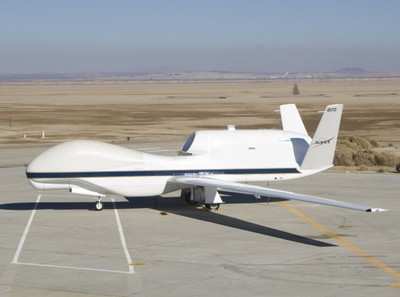
The approximately four-hour flight at NASA Dryden October 23rd
included checkout of aircraft systems, including engine,
flight controls and communication. The flight also included
demonstration of key features of a new ground control segment that
introduces Northrop Grumman's common mission management system
architecture. This architecture could serve as the baseline for
efforts to support the U.S. Department of Defense common ground
station initiative and future unmanned systems.
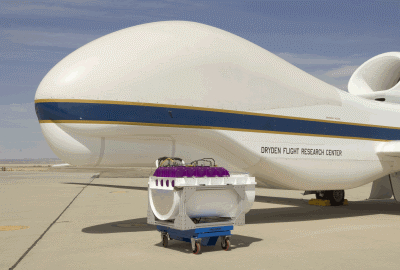
The first Earth science mission will be the joint NASA-NOAA
Global Hawk Pacific, or GloPac. This campaign will consist of six
long-duration missions over the Pacific and Arctic regions
scheduled to begin in early 2010. Eleven NASA and NOAA scientific
instruments integrated into one of NASA's Global Hawk aircraft will
collect atmospheric data while flying through the upper troposphere
and lower stratosphere. The primary science objective of the
mission is to perform calibration of instruments and validation of
data from the AURA satellite, one of NASA's 15 science satellites
currently observing the Earth.
"This is the future," said Paul Newman, project scientist for
the GloPac mission at NASA's Goddard Space Flight Center. "We are
taking the first steps into making scientific measurements with an
unmanned system -- a hybrid of a satellite and an aircraft."
"Northrop Grumman looks forward to the first GloPac flight,
which will herald yet another application of Global Hawk's
remarkable capabilities," said Corey Moore, vice president of
Advanced Concepts-Air and Land Systems for Northrop Grumman's
Aerospace Systems sector. "In addition to its support of the U.S.
Air Force in the war against terrorism, Global Hawk has been used
to help monitor wildfires in California and for hurricane relief
efforts along the Gulf Coast."
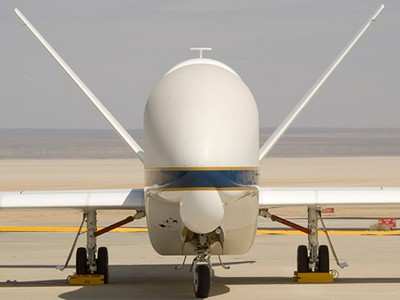
The two NASA Global Hawk aircraft were transferred to NASA
Dryden by the U.S. Air Force in 2007. NASA announced plans to use
them for missions supporting its Science Mission Directorate and
the Earth science community that require high-altitude,
long-endurance, long-distance airborne capability.
Northrop Grumman will share in use of the aircraft to conduct
its own flight demonstrations for expanded markets, missions and
airborne capabilities, including UAS integration into national
airspace.
Global Hawk can fly at altitudes up to more than 60,000 feet for
more than 30 hours at a time. In support of the Air Force, the
system provides persistent intelligence, surveillance and
reconnaissance to warfighters. To date, Global Hawks have flown
more than 33,000 hours.
Global Hawk also has many potential applications for the
advancement of science, improvement of hurricane monitoring
techniques, development of disaster support capabilities, and
development of advanced UAS technologies.



 ANN's Daily Aero-Term (05.05.24): Omnidirectional Approach Lighting System

 See All