
Airlines Finding Turboprops More Economical Than Regional Jets | Aero-News Network
Aero-News Network
RSS icon RSS feed
podcast icon MP3 podcast
Subscribe Aero-News e-mail Newsletter Subscribe

Airborne Unlimited -- Most Recent Daily Episodes

Episode Date

Airborne-Monday

Airborne-Tuesday

Airborne-Wednesday Airborne-Thursday

Airborne-Friday

Airborne On YouTube

Airborne-Unlimited-12.01.25

AirborneNextGen-
12.02.25

Airborne-Unlimited-12.03.25

Airborne-AffordableFlyers-11.20.25

AirborneUnlimited-11.21.25

LIVE MOSAIC Town Hall (Archived): www.airborne-live.net

Tue, Jul 10, 2012

Airlines Finding Turboprops More Economical Than Regional Jets

Many Airlines Shifting To More Efficient, Smaller Aircraft On Some Routes

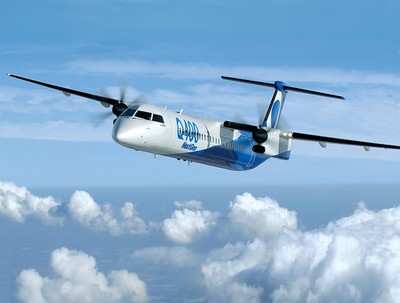
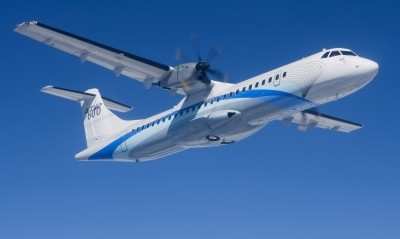
As some smaller and low-cost airlines look at short-haul domestic routes as a way to boost the bottom line, they're also finding that turboprop airplanes like the Bombardier Q400 and ATR-72 series are a better fit than single-aisle airliners, or even regional jets.

The Wall Street Journal reports that turboprops have been almost double that of regional jets over the past five years globally, driven largely by increases in fuel prices. The way the math works out, airlines can operate a 70 seat turboprop for about the same cost per passenger mile as they can a 50 seat RJ.

Another factor cited by WestJet, a Canadian carrier that flies a large fleet of Q400 aircraft, is that airlines can pay turboprop pilots less than their jet-qualified counterparts.

All of these factors have turboprop manufacturers like ATR in France and Bombardier in Canada ramping up their assembly lines to produce more airplanes. John Moore, head of sales for ATR, told the WSJ that there is a three-year backlog of orders, even when they boost production to seven airplanes a month by 2014. That's a 60% production increase.

The companies are also working to make the airplanes nicer inside for passengers. Philippe Poutissou, vice president for marketing at Bombardier's commercial aircraft unit said that the company is considering a 90-100 passenger version of the Q400, and ATR Chief Executive Filippo Bagnato said a stretched version of the ATR-72 might also make sense for the company.

The move is also sparking an increase in research and development of more efficient turboprop engines. It seems like for the foreseeable future, with fuel prices still unstable and airlines continuing to struggle, that the turboprops are back.

(Photos from file top: Bombardier Q400, bottom: ATR-72-600)

FMI: www.bombardier.com, www.atraircraft.com/

Advertisement

More News

Classic Aero-TV: VerdeGo Debuts VH-3 Hybrid-Electric Powerplant

From 2023 (YouTube Edition): New Propulsion Scheme Optimized for AAM Applications Founded in 2017 by Eric Bartsch, Pat Anderson, and Erik Lindbergh (grandson of famed aviation pion>[...]

NTSB Prelim: Grumman American Avn. Corp. AA-5B

During The Initial Climb, The Engine Began To Operate Abnormally And, After About Three Seconds, Experienced A Total Loss Of Power On October 29, 2025, about 1820 Pacific daylight >[...]

ANN's Daily Aero-Linx (12.02.25)

Aero Linx: Women in Aviation International Women in Aviation International is the largest nonprofit organization that envisions a world where the sky is open to all, and where avia>[...]

Aero-News: Quote of the Day (12.02.25)

“We’ve paid for the cable line’s repair for the customer and have apologized for the inconvenience this caused them...” Source: Some followup info from an A>[...]

Aero-News: Quote of the Day (12.03.25)

“We have long warned about the devastating effects of pairing optimization. Multiple times over many months, we highlighted how schedule manipulation, unbalanced schedules, a>[...]

blog comments powered by Disqus



Advertisement

Advertisement

Podcasts

Advertisement

© 2007 - 2025 Web Development & Design by Pauli Systems, LC

