SpaceX's Grasshopper Takes Giant Leap Towards Reusability With 12-Story Flight | Aero-News Network
Aero-News Network
RSS icon RSS feed
podcast icon MP3 podcast
Subscribe Aero-News e-mail Newsletter Subscribe

** AIRBORNE 05.24.13 Aero-TV-- CLICK HERE! ** HD iPad-Friendly Version -- AIRBORNE 05.24.13 **

** AIRBORNE 05.21.13 Aero-TV-- CLICK HERE! ** HD iPad-Friendly Version -- AIRBORNE 05.21.13 **

** AIRBORNE 04.01.13 SPECIAL EDITION of Aero-TV-- CLICK HERE! ** HD iPad-Friendly Version -- AIRBORNE 04.01.13 SPECIAL EDITION **

Thu, Dec 27, 2012

SpaceX's Grasshopper Takes Giant Leap Towards Reusability With 12-Story Flight

Twenty-Nine Second 'Hop' Tested Closed Loop Thrust Vector And Throttle Control

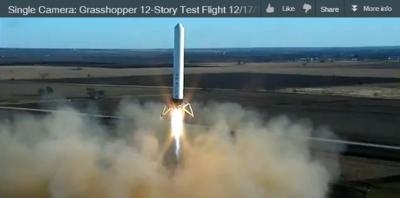
SpaceX's Grasshopper took a 12-story leap towards full and rapid rocket reusability in a test flight conducted December 17, 2012 at SpaceX’s rocket development facility in McGregor, Texas.

Grasshopper, SpaceX’s vertical takeoff and landing vehicle (VTVL), rose 131 feet, hovered and landed safely on the pad using closed loop thrust vector and throttle control. The total test duration was 29 seconds.

Grasshopper stands 10 stories tall and consists of a Falcon 9 rocket first stage, Merlin 1D engine, four steel landing legs with hydraulic dampers, and a steel support structure.

The 12-story flight marks a significant increase over the height and length of hover of Grasshopper’s previous test flights, which took place earlier this fall. In September, Grasshopper flew to 6 feet, and in November, it flew to 17.7 feet/2 stories including a brief hover.

Testing of Grasshopper will continue with successively more sophisticated flights expected over the next several months.

SpaceX is conducting the tests in three phases, with the first being these low-altitude short-duration flights. According to a draft FAA Environmental Impact Assessment published in 2011, in Phase 2, there would be slightly less propellant loaded, a different thrust profile, and the maximum altitude would be increased to 670 feet, still below Class E Airspace. The mission duration during Phase 2 is again approximately 45 seconds.

The goal of Phase 3 is to verify the Grasshopper RLV’s ability to perform a VTVL mission at higher altitudes and higher ascent speeds and descent speeds. To achieve this, the maximum mission altitude would be increased from 670 feet incrementally up to 11,500 feet. The altitude test sequence likely would be 1,200 feet; 2,500 feet; 5,000 feet; 7,500 feet; and 11,500 feet. The maximum test duration would be approximately 160 seconds. The Grasshopper RLV would land back on the launch pad.

(Image from SpaceX YouTube Video)

FMI: www.spacex.com

Advertisement

More News

ANN's Daily Aero-Linx (05.24.13)

Stormbirds A confederation of Luftwaffe-related web sites, providing reference-grade coverage of the Messerschmidt 262 and other advanced combat aircraft of the Third Reich.>[...]

ANN's Daily Aero-Term (05.24.13): Terrain/Obstruction Alert

A safety alert issued by ATC to aircraft under their control if ATC is aware the aircraft is at an altitude which, in the controller's judgment, places the aircraft in unsafe proxi>[...]

Aero-News: Quote Of The Day (05.24.13)

"You have a huge job ahead of you. The challenges are many and the solutions are hard." Source: Senate Commerce Committee Chair Jay Rockefeller (D-WV).>[...]

ANN FAQ: ANN's News Portal Syndication Program

Get A Customized ANN News Portal For YOUR Website! As we promised, the ever-so-busy software geeks at ANN have been working overtime on a number of cool new tools and toys... and t>[...]

AF Seven Summits Team Scales Everest

Effort To Raise Funds And Awareness For The Special Operations Warrior Foundation A group of Airmen with the Air Force Seven Summits team reached the highest point of the world, Mo>[...]

blog comments powered by Disqus


Advertisement

Advertisement

Podcasts

Advertisement

© 2007 - 2013 Web Development & Design by Pauli Systems, LC