Company, Pilots Cooperate In Developing New Air Cargo Fire Safety Technology
The General Civil Aviation Authority (United Arab Emirates) has released its final report concerning the fatal accident involving a United Parcel Service (UPS) B747-400 in Dubai on September 3, 2010. The report details facts concerning the accident, and makes recommendations addressing air cargo fire safety.

"Nearly three years following this tragic accident, UPS pilots welcome the release of this final report," said Independent Pilots Association (IPA) President Robert Travis. "Some of the GCAA's recommendations are already being addressed by a joint company and pilot union group, the IPA/UPS Safety Task Force, created shortly after the accident," he stated.
Travis said the union has worked with UPS to design, build, test and demonstrate for the FAA and NTSB an active fire suppression system capable of suppressing and containing a fire for up to four (4) hours. The technologies incorporated in that container, known as the Unit Load Device, consist of improved materials and a potassium based aerosol suppressant. "We encourage the FAA and UPS to move quickly and deliberately in approving and fully implementing this new technology," added Travis.
Prior to the release of the GCAA's final report, the UPS/IPA Safety Task Force recommended other safety measures that are being implemented by UPS including EVAS (Emergency Vision Assurance System), and quick donning full-face oxygen masks for all UPS aircraft. Both provide significant improvements on the flight deck during an onboard smoke, fire or fume event.
"We tragically lost two of our best pilots in the Dubai crash. As UPS pilots, we are determined to do everything in our power to minimize the risk associated with on-board smoke and fire events," said Travis. "This includes proper regulations governing the carriage of hazardous materials including lithium batteries."
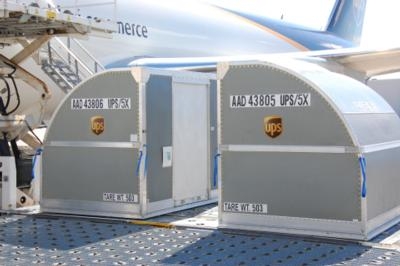
UPS has placed an industry-first order for 1,821 fire-resistant shipping containers. The implementation of these unit load devices (ULDs) represents a milestone in aviation history, offering unprecedented protection from intense fires. Delivery of the new containers will begin this September and is expected to be complete by early 2014.
The unit load devices (ULDs) will enhance safety on board the company's global fleet of cargo aircraft. "These containers are a game changer, both for UPS and the industry as a whole," said UPS Chief Operating Officer David Abney. "They represent a quantum leap forward in safety, an area where UPS places the highest emphasis."
"Fire onboard an aircraft has long been a top concern for the National Transportation Safety Board," said NTSB Chairman Deborah A.P. Hersman. "We commend UPS for implementing this real-world solution that addresses our recommendations."
The containers are built with a revolutionary new panel material, MACROLite, a fiber-reinforced plastic composite similar to the material used in ballistic body armor. Burn testing conducted by UPS and the FAA, and observed by the NTSB, has shown that a ULD with MACROLite panels can contain a fire with a peak temperature of 1,200 degrees Fahrenheit for more than four hours. That time frame would give a flight crew ample time to land safely in the event of an in-flight fire.
"We have tested these containers in the laboratory and in live operations. They will enhance safety and increase durability, and they are lighter, which will reduce fuel burn and supports our ongoing sustainability efforts," said UPS Airlines President Mitch Nichols.
(Image provided by UPS)



 Aero-News: Quote of the Day (12.07.25)


 See All