Second Special Behind-the-Scenes Tour Added For Space Center’s 50th Anniversary
For the first time in more than 30 years, NASA is allowing Kennedy Space Center Visitor Complex guests inside the Launch Control Center – where NASA directors and engineers supervised all of the 152 launches for the space shuttle and Apollo programs. The KSC Up-Close: Launch Control Center (LCC) Tour, the second in Kennedy Space Center’s special 50th anniversary series of rare-access tours, takes visitors inside Firing Room 4, one of the LCC’s four firing rooms and the one from which all 21 space shuttle launches since 2006 were controlled.
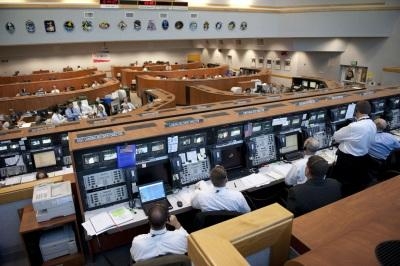
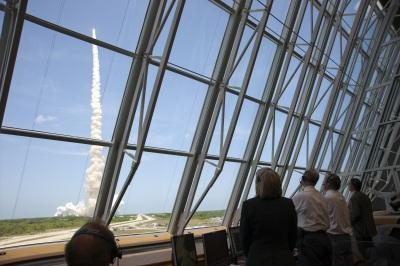
Inside Firing Room 4, visitors will pass by the computer consoles at which engineers monitored the computerized launch control system’s thousands of system checks every minute leading up to launch. They’ll see the main launch countdown clock and many large video monitors on the walls, and enter the “bubble room,” with its wall of interior windows through which the Kennedy Space Center management team viewed all of the proceedings below.
The most important person in Firing Room 4 was the launch director, who oversaw the entire process and made the final call on whether a launch was a “Go” or “No go.” “With so much on the line, the people who worked in this room were under tremendous pressure not only in daily operations but particularly as the countdown proceeded,” said Bob Sieck, former launch director, Kennedy Space Center. “They had to handle the tension and their emotions as the tests became faster, the astronauts took their place in the shuttle and thousands of people and news media were gathered outside to watch the launch.”
The LCC Tour opens June 15 and will run through the end of 2012 with a limited number of daily tours. NASA and the Kennedy Space Center Visitor Complex recently extended another behind-the-scenes tour through the end of the year. That tour, which began in November, takes visitors inside the 525-foot-tall Vehicle Assembly Building (VAB), the massive building adjacent to the LCC where the Apollo Saturn V rockets and space shuttles were assembled.
As with the VAB, visitors have not had access to the LCC since the 1970s, during the period after the Apollo and Skylab programs ended and before the first space shuttle launch in 1981. “This is another very rare opportunity that NASA has worked with us to provide – access to the Launch Control Center,” said Bill Moore, chief operating officer of Kennedy Space Center Visitor Complex. “It might be another 30 years before guests will receive a behind-the-scenes opportunity like this again.”
The LCC will continue to operate in guiding the next generation of rocket launches from Kennedy Space Center for NASA and potentially for commercial space programs. Future launches of SpaceX, whose recent launch from nearby Cape Canaveral Air Force Station resulted in the first mission by a commercial company to travel to and dock with the International Space Station, could take place from Kennedy Space Center beginning in 2013.
The LCC Tour is led by a trained space expert, giving visitors an insider’s view of the space program from launch preparation to liftoff. The tour also includes drive-by views of Launch Pad 39 and culminates at the Apollo/Saturn V Center, where visitors can resume the regular tour.
The LCC is also listed on the U.S. National Register of Historic Places and won an architectural award for industrial design from the American Institute of Architecture in 1965. The lead architect, Martin Stein, said the building’s prominent windows overlooking the launch pads of Launch Complex 39, where all of the shuttles and Saturn V rockets were launched, made a statement as windows “through which you could see mankind’s future.” (Images: Top KSC Firing Room, Bottom, KSC Bubble Room)



 ANN's Daily Aero-Term (12.01.25): Convective SIGMET


 See All