SpaceX’s Merlin 1D Engine Achieves Full Mission Duration Firing | Aero-News Network
Aero-News Network
RSS icon RSS feed
podcast icon MP3 podcast
Subscribe Aero-News e-mail Newsletter Subscribe

** AIRBORNE 06.18.13 Aero-TV-- CLICK HERE! ** HD iPad-Friendly Version -- AIRBORNE 06.18.13 **

** AIRBORNE 06.14.13 Aero-TV-- CLICK HERE! ** HD iPad-Friendly Version -- AIRBORNE 06.14.13**

** AIRBORNE 04.01.13 SPECIAL EDITION of Aero-TV-- CLICK HERE! ** HD iPad-Friendly Version -- AIRBORNE 04.01.13 SPECIAL EDITION **

Wed, Jun 27, 2012

SpaceX’s Merlin 1D Engine Achieves Full Mission Duration Firing

Nine Of The Engines Power The Falcon 9 Rocket

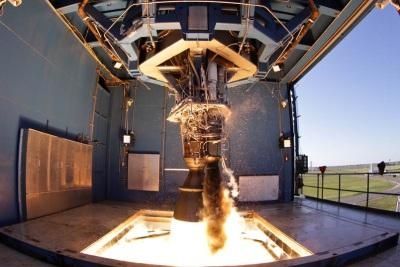
Space Exploration Technologies (SpaceX) announces that its Merlin 1D engine has achieved a full mission duration firing and multiple restarts at target thrust and specific impulse (Isp). The engine firing was for 185 seconds with 147,000 pounds of thrust, the full duration and power required for a Falcon 9 rocket launch. The tests took place at SpaceX's rocket development facility in McGregor, Texas.

"This is another important milestone in our efforts to push the boundaries of space technology,” said SpaceX CEO and Chief Designer Elon Musk. “With the Merlin 1D powering the Falcon 9 and Falcon Heavy rockets, SpaceX will be capable of carrying a full range of payloads to orbit.”

The Merlin 1D builds on the proven technology of the Merlin engines used on the first three flights of Falcon 9, including the recent historic mission to the International Space Station. With nine Merlins on the first stage, the Falcon 9 rocket will produce nearly 1.5 million pounds of thrust in a vacuum. An enhanced design makes the Merlin 1D the most efficient booster engine ever built, with a vacuum thrust-to-weight ratio exceeding 150, while still maintaining the structural and thermal safety margins needed to carry astronauts.

Additionally, as SpaceX continues to fulfill an extensive manifest of launches, the new engine is designed for improved manufacturability by using higher efficiency processes, increased robotic construction and reduced parts count.

The Merlin 1D engines will first see flight on Falcon 9 Flight 6, expected to launch in 2013. (Image provided by SpaceX)

FMI: www.spacex.com

Advertisement

More News

Aero-TV: Garmin’s GNC-255 –- Back To Basics

Garmin's New Aviation VHF Radios Early this year, a new series of aviation VHF COM and NAV/COM radios, the GTR and GNC series, was announced by Garmin. As the replacement products >[...]

EADS And Siemens Enter Long-Term Research Partnership

Sign MoU With Diamond Aircraft On Electric Propulsion System EADS and Siemens are entering into a long-term research partnership to introduce new electric propulsion systems that c>[...]

ANN's Daily Aero-Term (06.19.13): Ceiling

The heights above the earth's surface of the lowest layer of clouds or obscuring phenomena that is reported as broken, overcast, or obscuration, and not classified as thin or parti>[...]

ANN's Daily Aero-Linx (06.19.13)

The Army Aviation Heritage Foundation The Army Aviation Heritage Foundation (AAHF) is a non-profit public educational foundation dedicated to presenting the Army Aviation story to >[...]

Aero-News: Quote Of The Day (06.19.13)

“The serial electric propulsion allows us to design airplanes with totally different characteristics than today. Vertical take-off and high-speed cruise can be realized in a >[...]

blog comments powered by Disqus



Advertisement

Advertisement

Podcasts

Advertisement

© 2007 - 2013 Web Development & Design by Pauli Systems, LC