A Few Aero-Tips For The (Icing) Season #7: Braking Action Reports | Aero-News Network
Aero-News Network
RSS icon RSS feed
podcast icon MP3 podcast
Subscribe Aero-News e-mail Newsletter Subscribe

** AIRBORNE 05.21.13 Aero-TV-- CLICK HERE! ** HD iPad-Friendly Version -- AIRBORNE 05.21.13 **

** AIRBORNE 05.17.13 Aero-TV-- CLICK HERE! ** HD iPad-Friendly Version -- AIRBORNE 05.17.13 **

** AIRBORNE 04.01.13 SPECIAL EDITION of Aero-TV-- CLICK HERE! ** HD iPad-Friendly Version -- AIRBORNE 04.01.13 SPECIAL EDITION **

Fri, Jan 04, 2008

A Few Aero-Tips For The (Icing) Season #7: Braking Action Reports

Ice... Not Our Idea Of A Good Time

For those of us who have "hit the boots" (or the equivalent system on your favorite bird) a few times in the last few days due to the ever-present seasonal 'charms' of in-flight icing, we thought a series of short tips from Cirrus Design's Scott Winter (yes, that IS his real name) might help us all to consider some of the realities of this time of year. So... here are seven tips for dealing with icing. Y'all be careful out there!

Icing Aero-Tip 7: Braking Action Reports

When snow and ice cover a runway, braking action will likely be reduced. To inform pilots as to the current conditions of the runways, braking action reports will likely be made available. Braking action reports are reported as good, fair, poor or nil. Good means that there is no degradation of braking action. Fair means that there may be some degradation to braking action.

Poor means braking action is very degraded, and nil means there is no braking action. If a braking action report is between two conditions, i.e., fair to poor, pilots are encouraged to assume the worse of the two conditions or poor. Aside from verbal reports, airports may use MU (pronounced mew) values to determine braking effectiveness. At larger airports, a truck may drive on the runway with a device that measures surface friction to obtain MU values.

Anytime MU values are being reported, it is likely that there is some degradation to braking. MU values greater than 40 are considered "good," 40-30 are considered "fair," 30-20 are considered "poor," and values less than 20 are considered "nil." MU values are normally reported at three locations on a runway: touchdown, midfield, and rollout. Aside from MU values, inquire about runway conditions such as standing snow, melting ice, etc.

About Scott Winter

Scott is a member of the Flight Standards Department at Cirrus Design Corporation in Duluth, MN (one of those places that see more than its fair share of icing encounters). Born and raised in Milwaukee, WI, he discovered his passion for aviation at an early age. After obtaining his Private Pilot Certificate prior to his senior year in high school, he attended Minnesota State University, Mankato (MSU) and graduated with a Bachelor's degree majoring in Professional Flight. In December 2006, he completed his Master's of Science degree from MSU spending time focusing on aviation weather, scenario-based training, and visualization techniques to enhance the methods used to educate aviators.

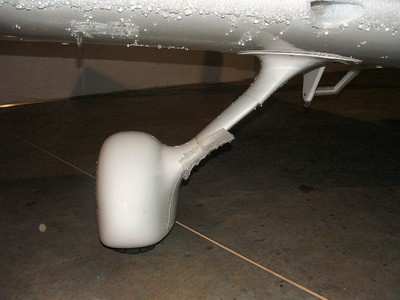
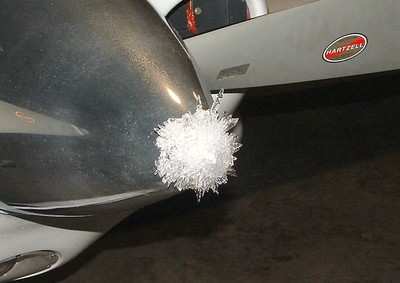
Note: ANN thanks Cirrus Pilot William Dobson and other members of the Cirrus community, for the use of the excellent SR20 icing pix...

FMI: www.cirrusdesign.com, www.aopa.org/asf/publications/sa11.pdf

Advertisement

More News

Four Companies Recognized With 2013 EBAA Safety Of Flight Awards

Cited For Focus On Maintaining And Improving Best Practices Four European companies have been recognized for their commitment to safe operations as recipients of the 2013 European >[...]

Classic Aero-TV: Viking Engines--Building A Rep For Alternative SportAv Engines

Rotax Is NOT The Only Player In Sport Aviation Propulsion Ya gotta hand to Viking... in an industry so VERY well dominated by Rotax, it takes some serious talent and extraordinary >[...]

ANN's Daily Aero-Linx (05.22.13)

The European Cockpit Association The European Cockpit Association (ECA) was created in 1991 and is the representative body of European pilots at European Union (EU) level. It repre>[...]

ANN's Daily Aero-Term (05.22.13): Known Traffic

With respect to ATC clearances, means aircraft whose altitude, position, and intentions are known to ATC.>[...]

Aero-News: Quote Of The Day (05.22.13)

"(T)he PC-24 is a completely new development – not a 'me too product'." Source: Oscar J. Schwenk, Chairman of the Board of Directors of Pilatus, introducing the company's new>[...]

blog comments powered by Disqus


Advertisement

Advertisement

Podcasts

Advertisement

© 2007 - 2013 Web Development & Design by Pauli Systems, LC