FAA/AST Report Focuses On Two Primary Areas
The FAA’s Office of Commercial Space Transportation (FAA/AST) and the Commercial Space Transportation Advisory Committee (COMSTAC) have prepared forecasts of global demand for commercial space launch services for the 10-year period from 2012 through 2021.
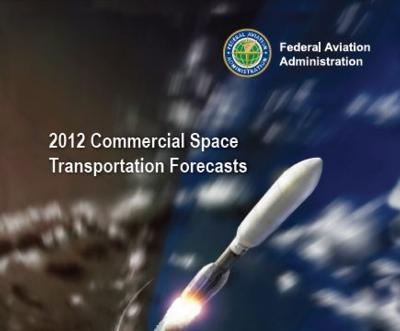
The 2012 Commercial Space Transportation Forecasts report is in two sections:
The COMSTAC 2012 Commercial Geosynchronous Orbit (GSO) Launch Demand Forecast, which projects demand for commercial satellites that operate in GSO and the resulting commercial launch demand to GSO.
The FAA’s 2012 Commercial Space Transportation Forecast for Non-Geosynchronous Orbits (NGSO), which projects commercial launch demand for satellites to NGSO, such as low Earth orbit (LEO), medium Earth orbit (MEO), elliptical (ELI) orbits, and external (EXT) orbits beyond the Earth.
Together, the COMSTAC and FAA forecasts project an average annual demand of 29.1 commercial space launches worldwide from 2012 through 2021, up from 28.6 launches in the 2011 forecasts. The reports project an average of 16.3 commercial GSO launches and 12.8 NGSO launches for 2012 through 2021.
In the report's executive summary, the FAA says it is important to distinguish between forecast demand and the number of satellites actually launched. Launch vehicle and satellite programs are complex, and susceptible to delays, which generally makes the forecast demand for launches the upper limit of actual launches in the near-term forecast.
The GSO market remains stable with a projected demand of 21.2 satellites per year, up slightly from last year’s projection of 20.5 satellites per year. Forty-three percent of GSO satellites projected to be launched from 2012 to 2021 are in the highest mass class (above 5,400 kilograms). In contrast, less than 5 percent of the satellites in the same period are in the lowest mass class (below 2,500 kilograms).
For NGSO, from 2012 to 2021, nearly 300 payloads are projected to launch commercially on 128 launches. The NGSO market projects an average of 12.8 launches per year from 2012 to 2021, which is slightly down from last year’s average of 13.0 launches. Fifty percent of the predicted launches over the next 10 years are for commercial cargo and crew transportation services to the International Space Station (ISS). Commercial crew transportation and resupply of the ISS are planned for vehicles that are yet to be proven. Technical or financial issues could delay ISS resupply launches. The NGSO telecommunication forecast shows a significant number of launches between 2012 and 2017, as Globalstar, ORBCOMM, and Iridium replace their constellations.
After 2017, NGSO telecommunication launch demand is projected to drop off, though unforeseen developments in this market could change this. The other NGSO markets, including commercial remote sensing and science and engineering, remain stable.
New commercial launch services providers such as SpaceX, with its Falcon 9 and Falcon Heavy, and Orbital Sciences Corp., with its Antares, are developing and demonstrating their vehicle capabilities for application to commercial and government markets. Lockheed Martin has recently stated its intentions to position the Atlas V more competitively in the commercial market through United Launch Alliance. Arianespace’s Vega small-class launch vehicle performed a successful inaugural flight in February 2012, and the Russian Soyuz launch vehicle had its debut launch from Kourou, French Guiana in October 2011. New vehicles expected to become available within the next two to three years include Athena (U.S.), Epsilon ( Japan), and Long March 6 (China).



 Airbus Racer Helicopter Demonstrator First Flight Part of Clean Sky 2 Initiative
 See All