Probe On Track To Orbit Planet In 2011
A NASA spacecraft gliding over the battered surface of Mercury
for the second time this year has revealed more previously unseen
real estate on the innermost planet. The probe also has produced
several science firsts and is returning hundreds of new photos and
measurements of the planet's surface, atmosphere and magnetic
field.
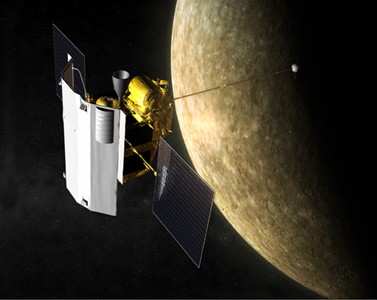
The MErcury Surface, Space ENvironment, GEochemistry, and
Ranging, or MESSENGER, spacecraft flew by Mercury shortly after
4:40 am EDT, on October 6. It completed a critical gravity assist
to keep it on course to orbit Mercury in 2011 and unveiled 30
percent of Mercury's surface never before seen by a spacecraft.
"The region of Mercury's surface that we viewed at close range
for the first time this month is bigger than the land area of South
America," said Sean Solomon, principal investigator and director of
the Department of Terrestrial Magnetism at the Carnegie Institution
of Washington. "When combined with data from our first flyby and
from Mariner 10, our latest coverage means that we have now seen
about 95 percent of the planet."
The spacecraft's science instruments operated throughout the
flyby. Cameras snapped more than 1,200 pictures of the surface,
while topography beneath the spacecraft was profiled with a laser
altimeter. The comparison of magnetosphere observations from the
spacecraft's first flyby in January with data from the probe's
second pass has provided key new insight into the nature of
Mercury's internal magnetic field and revealed new features of its
magnetosphere. The magnetosphere is the volume surrounding Mercury
that is controlled by the planet's magnetic field.
"The previous flybys by MESSENGER and Mariner 10 provided data
only about Mercury's eastern hemisphere," explains Brian Anderson
of the Johns Hopkins University Applied Physics Laboratory, known
as APL, in Laurel, MD. "The most recent flyby gave us our first
measurements on Mercury's western hemisphere, and with them we
discovered that the planet's magnetic field is highly
symmetric."
The probe's Mercury Laser Altimeter, or MLA, measured the
planet's topography, allowing scientists, for the first time, to
correlate high-resolution topography measurements with
high-resolution images.
"The MLA collected altimetry in regions where images from
MESSENGER and Mariner 10 data are available, and new images were
obtained of the region sampled by the altimeter in January," said
Maria Zuber, co-investigator and head of the Department of Earth,
Atmospheric, and Planetary Sciences at the Massachusetts Institute
of Technology. "These topographic measurements now improve
considerably the ability to interpret surface geology."
The Mercury Atmospheric and Surface Composition Spectrometer
observed Mercury's thin atmosphere, known as an exosphere. The
instrument searched for emissions from sodium, calcium, magnesium,
and hydrogen atoms. Observations of magnesium are the first
detection of this chemical in Mercury's exosphere. Preliminary
analysis suggests that the spatial distributions of sodium,
calcium, and magnesium are different. Simultaneous observations of
these spatial distributions, also a first for the spacecraft, have
opened an unprecedented window into the interaction of Mercury's
surface and exosphere.
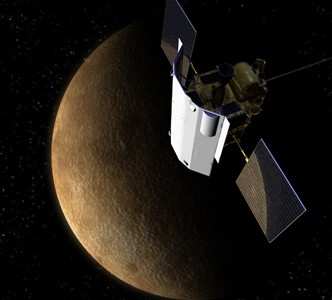
Spacecraft images also are revealing for the first time vast
geologic differences on the surface.
"Now that MESSENGER's cameras have imaged more than 80 percent
of Mercury, it is clear that, unlike the moon and Mars, Mercury's
surface is more homogeneously ancient and heavily cratered, with
large extents of younger volcanic plains lying within and between
giant impact basins," said co-investigator Mark Robinson of Arizona
State University in Tempe.
The project is the seventh in NASA's Discovery Program of
lower-cost, scientifically focused missions.



 Airborne 04.16.24: RV Update, Affordable Flying Expo, Diamond Lil


 See All