
Clark School Makes Four-Second Flight In Human-Powered Helicopter | Aero-News Network
Aero-News Network
RSS icon RSS feed
podcast icon MP3 podcast
Subscribe Aero-News e-mail Newsletter Subscribe

Airborne Unlimited -- Most Recent Daily Episodes

Episode Date

Airborne-Monday

Airborne-Tuesday

Airborne-Wednesday Airborne-Thursday

Airborne-Friday

Airborne On YouTube

Airborne-Unlimited-12.01.25

AirborneNextGen-
12.02.25

Airborne-Unlimited-12.03.25

Airborne-FltTraining-12.04.25

AirborneUnlimited-12.05.25

AFE 2025 LIVE MOSAIC Town Hall (Archived): www.airborne-live.net

Sat, May 14, 2011

Clark School Makes Four-Second Flight In Human-Powered Helicopter

University of Maryland's "Gamera" Claims World Record with Female Pilot Aboard, Confirmation Is Pending

A team of more than 50 students at the University of Maryland's A. James Clark School of Engineering has succeeded in flying their human-powered helicopter, Gamera. At approximately 1730 EDT on Thursday, pilot Judy Wexler, a 24-year-old biology graduate student at UM, pedaled furiously, taking the craft 3-5 inches into the air for about 4 seconds, setting a world record for human-powered helicopter flight with a female pilot.


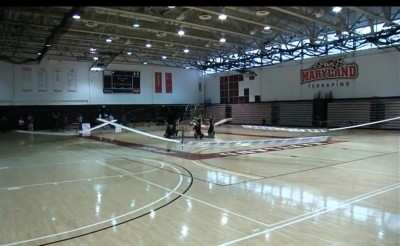
YouTube Frame Capture Of Gamera Flight

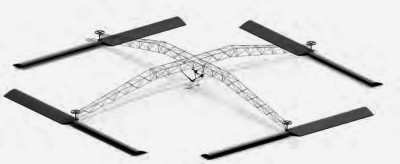
Gamera was designed and built by graduate and undergraduate students of the A. James Clark School of Engineering. Kristan Maynard, a judge from the National Aeronautics Association (NAA), announced that the flight looked successful, but the video must be reviewed before they will announce the official results. 


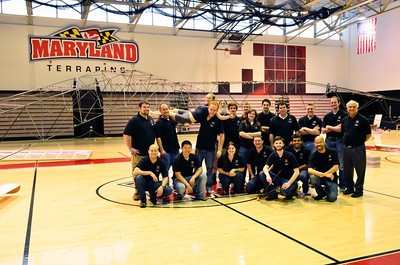
UMD Clark School Team

According to Mr. Maynard, no previous human-powered helicopter flight has been certified. So if the Gamera flight is certified, the vehicle will be the first in history to do so. Even if not certified, the Gamera flight will be the first to be piloted by a woman ... considered a major accomplishment for the Clark School of Engineering and its fantastic faculty, staff and students.

"I am incredibly proud of this amazing feat of engineering and physical prowess, and grateful to faculty mentors Drs. Inderjit Chopra, V.T. Nagaraj, and J. Gordon Leishman. Today’s flight of Gamera is a fitting symbol of our excellence in rotorcraft research and education, and our first step toward winning the Sikorsky Prize."

To claim the Sikorsky Prize, a human-powered rotary-wing aircraft must complete a flight of 60 seconds duration reaching an altitude of 3 meters (9.8 ft) while remaining in a 10 meter (32.8 ft) square.

FMI: www.eng.umd.edu

Advertisement

More News

ANN's Daily Aero-Term (12.04.25): Cooperative Surveillance

Cooperative Surveillance Any surveillance system, such as secondary surveillance radar (SSR), wide-area multilateration (WAM), or ADS-B, that is dependent upon the presence of cert>[...]

ANN's Daily Aero-Linx (12.04.25)

Aero Linx: OX5 Aviation Pioneers Incorporated in 1955 as a Pa 501 (c)(3) Not for Profit Corporation, the OX5 Aviation Pioneers is dedicated to bringing before the public the accomp>[...]

NTSB Prelim: Extra Flugzeugproduktions EA 300/SC

The Pilot Appeared To Regain Control After Six Rotations And Attempted To “Fly Out” Inverted But Had Insufficient Altitude On November 8, 2025, at 1038 eastern standard>[...]

Classic Aero-TV: The Bally Bomber - The All Time Ultimate Warbird Replica?

From 2018 (YouTube Edition): Aero-News Talks With The Airplane's Builder One of the many unique airplanes at AirVenture 2018 was a 1/3-scale B-17 bomber built by Jack Bally, who ta>[...]

ANN's Daily Aero-Linx (12.05.25)

Aero Linx: Society of U.S. Army Flight Surgeons (SoUSAFS) The Society of US Army Flight Surgeons (SoUSAFS) serves to advance the science and art of Aerospace Medicine and its allie>[...]

blog comments powered by Disqus



Advertisement

Advertisement

Podcasts

Advertisement

© 2007 - 2025 Web Development & Design by Pauli Systems, LC

