
NASA, NOAA Convene GOES 17 Mishap Investigation Board | Aero-News Network
Aero-News Network
RSS icon RSS feed
podcast icon MP3 podcast
Subscribe Aero-News e-mail Newsletter Subscribe

Airborne Unlimited -- Most Recent Daily Episodes

Episode Date

Airborne-Monday

Airborne-Tuesday

Airborne-Wednesday Airborne-Thursday

Airborne-Friday

Airborne On YouTube

Airborne-Unlimited-12.01.25

AirborneNextGen-
12.02.25

Airborne-Unlimited-11.19.25

Airborne-AffordableFlyers-11.20.25

AirborneUnlimited-11.21.25

LIVE MOSAIC Town Hall (Archived): www.airborne-live.net

Mon, Oct 08, 2018

NASA, NOAA Convene GOES 17 Mishap Investigation Board

Will Look Into An Instrument Anomaly Aboard The Orbiting Spacecraft

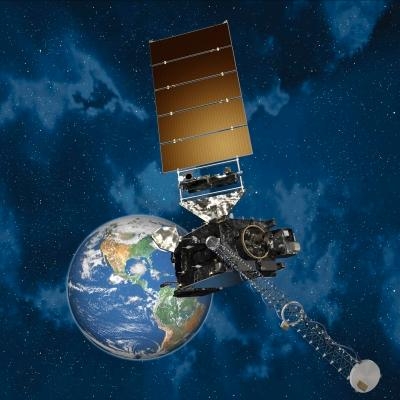
NASA and the National Oceanic and Atmospheric Administration (NOAA) have appointed a board to investigate an instrument anomaly aboard the Geostationary Operational Environmental Satellite (GOES) 17 weather satellite currently in orbit.

During postlaunch testing of the satellite's Advanced Baseline Imager (ABI) instrument, it was discovered that the instrument's infrared detectors cannot be maintained at their required operating temperatures under certain seasonal and orbital conditions, resulting in a loss of approximately three percent of the instrument's availability over the course of a year. This loss exceeds a key design requirement.

NASA and NOAA senior leadership have determined the need to convene the mishap investigation board, which will work to determine the root or proximate cause of the anomaly and identify actions to prevent occurrences on future satellites. The board will begin its work as soon as possible.

David McGowan, chief engineer at NASA's Langley Research Center, will chair the five-member board. The other four members are:

Dr. Joel Lachter, human factors investigator, NASA's Ames Research Center
Rich Slywczak, safety officer, NASA's Glenn Research Center
Hank Rotter, NASA Engineering and Safety Center technical fellow for active thermal systems, NASA's Johnson Space Center
Julie Grantier, senior technical lead for systems engineering, NASA's Glenn Research Center
GOES-17 is one of several next-generation weather satellites in the GOES-R series, including GOES-16, which currently serves as the operational geostationary weather satellite over the U.S. East coast. Later this year, GOES-17 will become operational as the GOES West satellite. Two additional satellites, GOES-T and GOES-U, are currently in development. The advanced instrument technology used on these satellites is contributing to more timely and accurate weather forecasts and warnings.

The GOES-R Series program is a collaborative effort between NOAA, NASA and industry partners. NOAA manages the GOES-R Series program through an integrated NOAA/NASA office at NASA's Goddard Space Flight Center in Greenbelt, Maryland. NASA also oversees the acquisition of the spacecraft, instruments and launch vehicles. Mission operations are performed by NOAA at the NOAA Satellite Operations Facility in Suitland, Maryland.

(Source: NASA news release. Image from file)

FMI: www.goes-r.gov

Advertisement

More News

ANN's Daily Aero-Term (12.01.25): Convective SIGMET

Convective SIGMET A weather advisory concerning convective weather significant to the safety of all aircraft. Convective SIGMETs are issued for tornadoes, lines of thunderstorms, e>[...]

ANN's Daily Aero-Linx (12.01.25)

Aero Linx: United Flying Octogenarians WELCOME to a most extraordinary group of aviators, the United Flying Octogenarians (UFO). Founded in 1982 with just a handful of pilots, we h>[...]

NTSB Final Report: Remos Aircraft GmbH Remos GX

Pilot’s Decision To Attempt Takeoff With Frost Covering The Airplane’s Wings Analysis: The pilot of the light sport airplane was preparing to depart for a cross-country>[...]

Aero-News: Quote of the Day (12.02.25)

“We’ve paid for the cable line’s repair for the customer and have apologized for the inconvenience this caused them...” Source: Some followup info from an A>[...]

ANN's Daily Aero-Term (12.02.25): Coupled Approach

Coupled Approach An instrument approach performed by the aircraft autopilot, and/or visually depicted on the flight director, which is receiving position information and/or steerin>[...]

blog comments powered by Disqus



Advertisement

Advertisement

Podcasts

Advertisement

© 2007 - 2025 Web Development & Design by Pauli Systems, LC

