
Pro Aerobatic Pilot Set To Crush World Record For Most Inverted Flat Spins | Aero-News Network
Aero-News Network
RSS icon RSS feed
podcast icon MP3 podcast
Subscribe Aero-News e-mail Newsletter Subscribe

Airborne Unlimited -- Most Recent Daily Episodes

Episode Date

Airborne-Monday

Airborne-Tuesday

Airborne-Wednesday Airborne-Thursday

Airborne-Friday

Airborne On YouTube

Airborne-SpecialEpisode-12.15.25

AirborneNextGen-
12.16.25

Airborne-Unlimited-12.10.25

Airborne-AffordableFlyers-12.11.25

AirborneUnlimited-12.12.25

AFE 2025 LIVE MOSAIC Town Hall (Archived): www.airborne-live.net

Tue, Feb 12, 2019

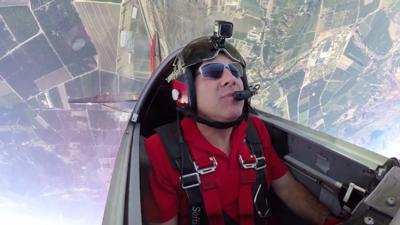
Pro Aerobatic Pilot Set To Crush World Record For Most Inverted Flat Spins

Spencer Suderman Will Attempt To Break His Own Record Sunday

Plummeting toward the ground in a plane that is upside down and spinning is Spencer Suderman’s signature move. The maneuver is called an inverted flat spin, and on February 17, 2019, the professional aerobatic pilot will attempt to smash his own world record by spinning his biplane 120 times over Yuma, Arizona.

Suderman, who lives in St. Augustine, Florida, is an air show performer and two-time Guinness World Records title holder for the most inverted flat spins in an aircraft. For this attempt, Suderman will fly an experimental Pitts Special S-1c. The plane is a different version of the one he used in 2016 to set the current world record of 98 spins. It is lighter and has a flat bottom wing, which lowers the stall speed and should allow it to reach a higher altitude. It also has a smaller engine that was custom built with extreme modifications for the attempt.

Suderman says he wants to do more than just break his own world record, he wants to crush it. “Go big or stay home! I want the world to see that an ordinary person can do amazing things and get so far ahead that no one wants to catch up.”

Suderman will start the maneuver at around 27,000 feet and anticipates it will take between three-and-a-half and four minutes to complete 120 spins. “High altitude flying is inherently risky,” says Suderman. “A failure in the oxygen system at attitude is potentially fatal.” The recovery is set to occur at 2000 feet above ground level, and according to Suderman, if something goes wrong at that point, bailing out high enough for the parachute to work is not guaranteed.

(Source: Spencer Suderman news release. Image from file)

FMI: www.spencersuderman.com

Advertisement

More News

ANN's Daily Aero-Term (12.19.25): Ultrahigh Frequency (UHF)

Ultrahigh Frequency (UHF) The frequency band between 300 and 3,000 MHz. The bank of radio frequencies used for military air/ground voice communications. In some instances this may >[...]

NTSB Prelim: Cirrus Design Corp SR22T

During The 7 Second Descent, There Was Another TAWS Alert At Which Time The Engine Remained At Full Power On October 24, 2025 at 2115 mountain daylight time, a Cirrus SR22T, N740TS>[...]

Classic Aero-TV: The Red Tail Project--Carrying the Torch of the Tuskegee Airmen

From 2009 (YouTube Edition): Educational Organization Aims to Inspire by Sharing Tuskegee Story Founding leader Don Hinz summarized the Red Tail Project’s mission in simple, >[...]

Aero-News: Quote of the Day (12.19.25)

“This feels like an important step since space travel for people with disabilities is still in its very early days... I’m so thankful and hope it inspires a change in m>[...]

Airborne 12.17.25: Skydiver Hooks Tail, Cooper Rotax Mount, NTSB v NDAA

Also: New Katanas, Kern County FD Training, IndiGo’s Botched Roster, MGen. Leavitt Named ERAU Dean The Australian Transportation Safety Bureau (ATSB) has wrapped up its inves>[...]

blog comments powered by Disqus



Advertisement

Advertisement

Podcasts

Advertisement

© 2007 - 2025 Web Development & Design by Pauli Systems, LC

