San Diego Aerospace Museum Event To Honor Russia’s
Heroines
It's quite literally something you don't see much at all. Women
in the cockpits of World War II fighters -- in combat.

The San Diego Aerospace Museum stages a symposium June 18, 2005
at 1400, featuring five women who served with the Soviet Army Air
Regiments during World War II, known by Russians as the Great
Patriotic War.
When Germany launched "Operation Barbarossa," the Nazi invasion
of the Soviet Union on June 22, 1941, the Soviet Air Force was
caught on the ground and nearly annihilated. The Soviet Union
formed three air regiments of female combatants at the behest of
Marina Raskova. Raskova, Russia’s Amelia Earhart of the time
convinced Stalin to allow women to help in the fight and, on
October 8, 1941, an order by the People’s Commissariat of
Defense was issued for the formation of three female air
regiments.
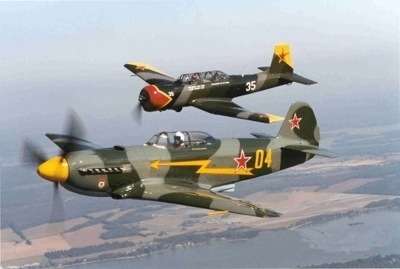
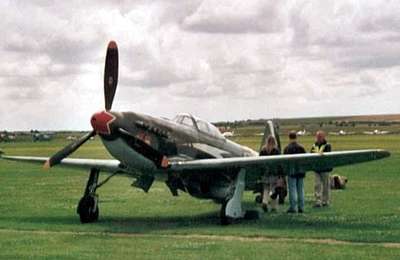
The 586th Air Regiment maintained and flew fighter aircraft such
as the Yak-1, Yak-7 and Yak-9. The 587th Bomber Aviation Regiment
flew the Petlyakov Pe-2, a complex twin-engine dive-bomber. The
female pilots of this aircraft used the services of their
navigator/bombardier to assist them in talking off from the
airfield by pushing on their backs to keep them far enough ahead in
their seat.
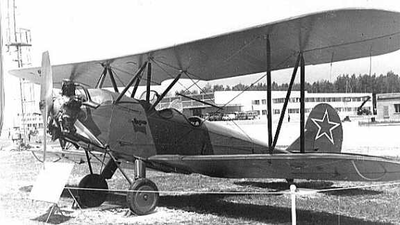
The women of the 588th Air Regiment were given the Polikarpov
Po-2, an obsolescent open cockpit biplane made of mostly of tube
and fabric. Most Po-2 pilots were not issued a parachute until the
end of the war and operated without a radio on board. The female
Po-2 pilots were assigned the mission of flying night harassment
raids against the Germans – sometimes five to 15 missions a
night in the brutal Russian winter flying low and slow over their
targets while caught in a web of searchlights and flak.
The deadly success of these missions and the fear which
permeated the targeted German ground forces led Hitler himself to
offer a special medal to anyone who shot down these small biplanes.
For the Soviet cause, the female pilots were heroines; to the
Germans they were the "Nachthexen" – the "Night Witches."
By the end of WWII, nearly 1,000 Russian women had flown Soviet
combat aircraft, ranging from fighters to dive-bombers with valor
and bravery. These regiments included female pilots, navigators,
mechanics and armament mechanics. Russia’s highest military
honor -- Hero of the Soviet Union was awarded to hundreds in the
Soviet Air Force. The 587th (later the 125th Guards Bomber Aviation
Regiment) earned five HSU awards and the 588th Regiment earned 23.
However, as historians contend to this day the 586th Fighter
Aviation Regiment, which produced at least two fighter aces, has
never really received the recognition it is due.
Noted historian, Dr. Kazimiera J. Cottam will moderate the
symposium and provide an intriguing detailed historical background.
Then, with the assistance of a translator, each Russian air veteran
will give her personal account. A question and answer session with
audience participation will follow.
After the speaking portion of the event, Dr. Cottam will sign
copies of her two books written on the subject available for
purchase at the event – Women in War and Resistance and Women
in Air War. Also, former Ann Noggle, a former WASP will also sign
copies of her book, A Dance with Death: Soviet Airwomen in World
War II. Both authors will have books available for purchase at the
event.
In addition, a silent auction will be held with proceeds
benefiting the travel expenses from Russia. Items in the auction
will include autographed aircraft models of the Yak-1, Pe-2 and
Po-2.
The women scheduled to participate at the symposium are:
46th Guards Bomber Regiment - The 588th Air Regiment was
activated in the summer of 1942 and in 1943 was honored by being
designated as a Guards regiment. Henceforth, the regiment was
officially known as the 46th Taman Guards Bomber Regiment. The
regiment was equipped with the Po-2, a Polikarpov open-cockpit
biplane made of fabric and wood, fitted with a 100 hp five-cylinder
radial engine. The mission of the night bomber regiment was to
destroy tactical targets located close to the front lines, such as
fuel depots, ground troops bridges and ammunition dumps. The Po-2
was fitted with bomb racks and a light machine gun in the rear
cockpit. The crew relied heavily on the dark of night for
protection when flying over heavily defended targets.
Nadezhda Vasil’ezna Popova
Po-2 pilot, Squadron Commander
Hero of the Soviet Union
Flew 852 combat missions, shot down several times
586th Air Defense Fighter Regiment - The 586th became
operational in April 1942. As a defense regiment, its primary duty
was to guard important targets from enemy bombers and to escort
aircraft of important persons. The regiment was initially equipped
with the Yak-1, a single-seat low-wing aircraft with a 1,100 hp
engine. It had a top speed of 400 mph and carried two small caliber
machine guns.
Tamara Ustinovna Pamiatnykh
Yak pilot, Squadron Commander
Shot down German bombers
Awarded Soviet Order of the Red Star
Recognized for heroics by the King of England
Ekaterina Kuz’minichna Polunina
Sr. Mechanic, maintaining Yaks during war
now the 586th Regiment historian

The 125th Guards Dive Bomber Regiment - The 587th Bomber
Regiment was honored during the war and was renamed the 125th M.M.
Raskova Borisov Guards Bomber Regiment. The aircraft flown by this
regiment were considered to be the most complex of the Soviet-made
aircraft. Less experienced pilots were often afraid of the
Petlyakov Pe-2, while more competent pilots were said to love it.
The twin-engine, twin-tail dive-bomber was powered by two 1,100 hp
engines and could reach a maximum speed of 336 mph at 16,400 feet.
It carried a 1,000 kg bomb load and a crew of three: pilot,
navigator-bombardier and tail-gunner.
Galina Pavlovna Brok-Bel’tsova
Pe-2 Navigator-Bombardier
Survived Focke-Wulf attack
Anna Ivanovna Kirilina
Armament Mechanic for Pe-2
Maintained and loaded bombs and machine guns

While in San Diego, the airwomen will be treated to the
hospitality offered by MCAS Miramar during a trip to the base. A
unique juxtaposition between countries, wars, technology and
cultures will prove to be a very interesting day for all
parties.



 Classic Aero-TV: Remembering Bob Hoover

 See All