
AP: FAA Trying To Prevent Release Of Bird Strike Data | Aero-News Network
Aero-News Network
RSS icon RSS feed
podcast icon MP3 podcast
Subscribe Aero-News e-mail Newsletter Subscribe

** AIRBORNE 06.18.13 Aero-TV-- CLICK HERE! ** HD iPad-Friendly Version -- AIRBORNE 06.18.13 **

** AIRBORNE 06.14.13 Aero-TV-- CLICK HERE! ** HD iPad-Friendly Version -- AIRBORNE 06.14.13**

** AIRBORNE 04.01.13 SPECIAL EDITION of Aero-TV-- CLICK HERE! ** HD iPad-Friendly Version -- AIRBORNE 04.01.13 SPECIAL EDITION **

Sat, Mar 28, 2009

AP: FAA Trying To Prevent Release Of Bird Strike Data

Agency Concerned Report Could "Unfairly Cast Aspersions" On Safety

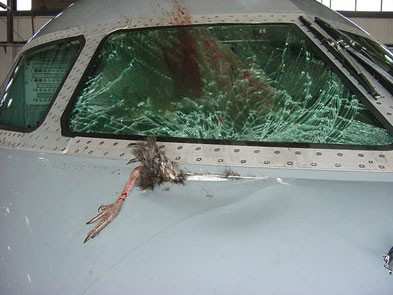
Though the matter of airplane bird strikes has only recently caught the attention of the general public, with the January 15 "Miracle on the Hudson" ditching of a US Airways A320... in truth it's been a problem since the dawn of flight.

But just how big a problem is it? Funny thing is, the FAA doesn't want you to know.

The agency had planned to release its 19-year-old database on bird strikes, following a Freedom of Information Act request submitted by The Associated Press. The FAA told the AP it would release the data within days, following a February 18 conference call.

Well, it's now March 28... and still no report. The AP reports the FAA submitted a proposal Tuesday, asking for permission to keep the data private... citing concerns about the safety image of the airline industry, and of certain airports.

"The agency is concerned that there is a serious potential that information related to bird strikes will not be submitted because of fear that the disclosure of raw data could unfairly cast unfounded aspersions on the submitter," the FAA noted in the Federal Register.

That line of reasoning probably sounds familiar if you followed the hoops NASA jumped through two years ago, as it worked to prevent the release of data obtained through the voluntary National Aviation Operations Monitoring Study. Critics slammed the agency, saying it was not NASA's role to protect the airlines' public image.

Eventually, NASA capitulated... sort of. As ANN reported, the agency released the data on the last day of 2007. It also took pains to obfuscate the results, so it was impossible for researchers to establish clear trends.

The similarity in reasoning was also noticed by others. "It sounds like the FAA is going back to their early 1990s view that their job is to promote the carriers and look out for their bottom line," said Mary Schiavo, former Transportation Department inspector general.

"They were criticized for that and then said they also were concerned with safety, but this sounds like they're reverting to being cheerleaders for the industry."

FMI: www.faa.gov

Advertisement

More News

Aero-TV: Garmin’s GNC-255 –- Back To Basics

Garmin's New Aviation VHF Radios Early this year, a new series of aviation VHF COM and NAV/COM radios, the GTR and GNC series, was announced by Garmin. As the replacement products >[...]

EADS And Siemens Enter Long-Term Research Partnership

Sign MoU With Diamond Aircraft On Electric Propulsion System EADS and Siemens are entering into a long-term research partnership to introduce new electric propulsion systems that c>[...]

ANN's Daily Aero-Term (06.19.13): Ceiling

The heights above the earth's surface of the lowest layer of clouds or obscuring phenomena that is reported as broken, overcast, or obscuration, and not classified as thin or parti>[...]

ANN's Daily Aero-Linx (06.19.13)

The Army Aviation Heritage Foundation The Army Aviation Heritage Foundation (AAHF) is a non-profit public educational foundation dedicated to presenting the Army Aviation story to >[...]

Aero-News: Quote Of The Day (06.19.13)

“The serial electric propulsion allows us to design airplanes with totally different characteristics than today. Vertical take-off and high-speed cruise can be realized in a >[...]

blog comments powered by Disqus



Advertisement

Advertisement

Podcasts

Advertisement

© 2007 - 2013 Web Development & Design by Pauli Systems, LC