Milestone Accomplished On Schedule; Certification Program Begins In 2018
GE Aviation's Advanced Turboprop engine, the first clean-sheet turboprop engine to hit the Business and General Aviation (BGA) market in more than 30 years, successfully completed its first engine test run at GE Aviation's facility in Prague, Czech Republic, on Friday (December 22).
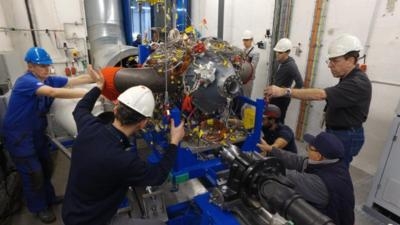
"Running the Advanced Turboprop engine this year was our biggest and most important goal," said Brad Mottier, vice president and general manager of GE Aviation's BGA and Integrated Systems organization. "This milestone comes as a result of two years of tremendous effort by a worldwide team. We're developing a real catalyst for the BGA market and we're executing on plan. The integration of proven technologies has expedited the design, development and certification cycle of the engine."
The Advanced Turboprop engine will begin certification testing in 2018. The engine will power Textron Aviation's new Cessna Denali, which is expected to fly in late 2018. By the time the Denali enters into service, the engine will have completed more than 2000 hours of testing.
"The continued testing will generate valuable data from the engine and validate the aerodynamics, mechanics, and aerothermal systems," said Paul Corkery, general manager for GE Aviation Turboprops. "With the engine run and most of the individual component testing completed, early indications show that we will meet or exceed all the performance numbers we have quoted for the engine."
The new 1,240 SHP-rated Advanced Turboprop engine is in the family of turboprop engines aimed at BGA aircraft in the 1,000-1,600 SHP range. With 79 new technologies introduced, the engine offers a portfolio of advanced technology, as well as unparalleled performance and efficiency.
The Advanced Turboprop engine features an industry-best 16:1 overall pressure ratio, enabling the engine to achieve as much as 20 percent lower fuel burn and 10 percent higher cruise power compared to competitor offerings in the same size class. At 4,000 hours, it offers 33 percent more time between overhaul than its leading competitor.
When installed on the Denali, these engine efficiencies allow for a larger cabin experience with a comfortable 6000-foot cabin altitude at a 30,000-foot cruising altitude, as well as class-leading low cost of operation compared to smaller aircraft in the category.
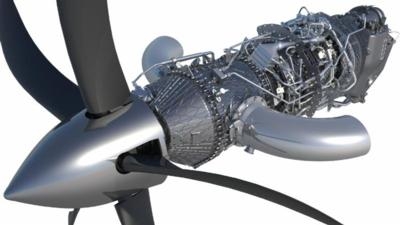
The Advanced Turboprop engine's proven technology developed from GE's large commercial and regional engines has reduced engine development risk and timing. It is the first turboprop engine in its class to introduce two stages of variable stator vanes and cooled high-pressure turbine blades, proven technologies developed by GE in its large commercial engines and flown more than 1.3 billion flight hours. With the use of advanced 3-dimensional aerodynamics, improved materials, and cooled turbine technologies, the Advanced Turboprop engine will deliver significantly higher efficiency, as well as greater performance and durability than other engines in its class.
The Advanced Turboprop engine includes more printed components than any production engine in aviation history with 35 percent of the turboprop's parts built via additive manufacturing. A total of 855 conventionally manufactured parts has been reduced to 12 additive parts, including sumps, bearing housings, frames, exhaust case, combustor liner, heat exchangers and stationary flow path components. Additive components reduce the ATP's weight by 5 percent while contributing a 1 percent improvement in specific fuel consumption (SFC).
Since Mottier unveiled the Advanced Turboprop engine at the National Business Aviation Association (NBAA) Convention in November of 2015, GE Aviation has committed more than $400 million in development costs for the engine. GE also finalized an agreement with the Czech government to build its new turboprop headquarters for development, test and engine-production in the Czech Republic. When complete and at full production rate, this new facility is expected to have 500 additional employees. GE Aviation Czech has already added around 180 jobs, with another 80 expected in 2018.
(Images provided with GE Aviation news release)



 ANN's Daily Aero-Term (12.08.25): Decision Altitude (DA)


 See All