
GPS III Satellite Responding To Commands, Under Self-Propulsion | Aero-News Network
Aero-News Network
RSS icon RSS feed
podcast icon MP3 podcast
Subscribe Aero-News e-mail Newsletter Subscribe

Airborne Unlimited -- Most Recent Daily Episodes

Episode Date

Airborne-Monday

Airborne-Tuesday

Airborne-Wednesday Airborne-Thursday

Airborne-Friday

Airborne On YouTube

Airborne-Unlimited-12.01.25

AirborneNextGen-
12.02.25

Airborne-Unlimited-12.03.25

Airborne-FltTraining-12.04.25

AirborneUnlimited-12.05.25

AFE 2025 LIVE MOSAIC Town Hall (Archived): www.airborne-live.net

Sun, Aug 25, 2019

GPS III Satellite Responding To Commands, Under Self-Propulsion

First GPS III Satellite Successfully Completes On-Orbit Testing

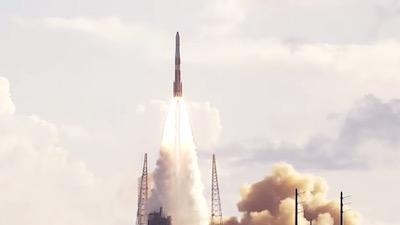
The U.S. Air Force's second next-generation GPS III satellite, built by Lockheed Martin, is responding to commands, under control and now using its own internal propulsion system to get to orbit following its successful launch Thursday morning.

At about 11:01 a.m. ET, Air Force and Lockheed Martin engineers at Lockheed Martin's Launch & Checkout Facility near Denver declared they had full control of GPS III Space Vehicle 02 (GPS III SV02) shortly after the satellite's separation from its United Launch Alliance (ULA) Delta IV rocket booster. The satellite, nicknamed "Magellan" by the Air Force, began its rocket ride to space with a 9:06 a.m. ET launch from Cape Canaveral Air Force Station.

GPS III SV02 is now climbing towards its operational orbit about 12,550 miles above the earth under the power of its own Liquid Apogee engines. Engineers at Lockheed Martin Space's Waterton, Colorado facility are commanding the satellite using elements of the GPS Next Generation Operational Control System (OCX) Block 0.

"GPS III SV02 is receiving and responding to commands just as planned. In the days ahead, we'll finish orbit raising to our operational slot and then send the satellite commands telling it to to deploy its solar arrays and antennas," said Johnathon Caldwell, Lockheed Martin Space's vice president for Navigation Systems. "Once we are set up, we'll begin on-orbit checkout and tests, including extensive signals testing with our advanced navigation payload."

GPS III SV02 is the second GPS III satellite designed and built by Lockheed Martin to help the Air Force modernize today's Global Positioning System (GPS) constellation with new technology and capabilities. GPS III satellites provide 3x greater accuracy and up to 8x improved anti-jamming capabilities. GPS III also provides a new L1C civil signal, compatible with other international global navigation satellite systems, like Europe's Galileo.

GPS III SV02 will be the second GPS III satellite in orbit and the second GPS III satellite now being commanded from Lockheed Martin Space's facility.

On December 23, 2018, the Air Force launched the first GPS III satellite. Nicknamed "Vespucci," GPS III SV01 underwent months of checkout and thorough testing of its advanced, new navigation payload provided by Harris Corporation.

"GPS III SV01's performance exceeded expectations during testing," Caldwell said. "On July 12, we officially completed all On Orbit Check Out & Test activities. We are excited to see this satellite move to the next phase and perform in an operational environment."

That's expected to happen later this year once the first satellite is handed over to the Air Force.

(Source: Lockheed Martin news release)

FMI: www.lockheedmartin.com

Advertisement

More News

ANN's Daily Aero-Term (12.04.25): Cooperative Surveillance

Cooperative Surveillance Any surveillance system, such as secondary surveillance radar (SSR), wide-area multilateration (WAM), or ADS-B, that is dependent upon the presence of cert>[...]

ANN's Daily Aero-Linx (12.04.25)

Aero Linx: OX5 Aviation Pioneers Incorporated in 1955 as a Pa 501 (c)(3) Not for Profit Corporation, the OX5 Aviation Pioneers is dedicated to bringing before the public the accomp>[...]

NTSB Prelim: Extra Flugzeugproduktions EA 300/SC

The Pilot Appeared To Regain Control After Six Rotations And Attempted To “Fly Out” Inverted But Had Insufficient Altitude On November 8, 2025, at 1038 eastern standard>[...]

Classic Aero-TV: The Bally Bomber - The All Time Ultimate Warbird Replica?

From 2018 (YouTube Edition): Aero-News Talks With The Airplane's Builder One of the many unique airplanes at AirVenture 2018 was a 1/3-scale B-17 bomber built by Jack Bally, who ta>[...]

ANN's Daily Aero-Linx (12.05.25)

Aero Linx: Society of U.S. Army Flight Surgeons (SoUSAFS) The Society of US Army Flight Surgeons (SoUSAFS) serves to advance the science and art of Aerospace Medicine and its allie>[...]

blog comments powered by Disqus



Advertisement

Advertisement

Podcasts

Advertisement

© 2007 - 2025 Web Development & Design by Pauli Systems, LC

