USAF Report Indicates Microburst A Factor In C-130 Firefighting Accident | Aero-News Network
Aero-News Network
RSS icon RSS feed
podcast icon MP3 podcast
Subscribe Aero-News e-mail Newsletter Subscribe

** AIRBORNE 06.18.13 Aero-TV-- CLICK HERE! ** HD iPad-Friendly Version -- AIRBORNE 06.18.13 **

** AIRBORNE 06.14.13 Aero-TV-- CLICK HERE! ** HD iPad-Friendly Version -- AIRBORNE 06.14.13**

** AIRBORNE 04.01.13 SPECIAL EDITION of Aero-TV-- CLICK HERE! ** HD iPad-Friendly Version -- AIRBORNE 04.01.13 SPECIAL EDITION **

Fri, Nov 16, 2012

USAF Report Indicates Microburst A Factor In C-130 Firefighting Accident

Crew Misjudged Wind Conditions While Flying In The South Dakota Black Hills

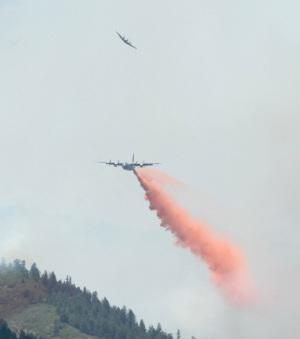
The crew of a MAFFS C-130 engaged in a firefight mission misjudged wind conditions and flew into the area of a microburst, which caused the airplane to impact the ground. That is the assessment of an Air Force accident panel investigating the crash.

The accident occurred July 1. In releasing an executive summary of the full report from the Air Force Mobility Command, Brig. Gen. Randall Guthrie said that the pilots' actions allowed two crewmembers in the back of the plane to survive the accident.

Stars and Stripes reports that the investigation found that that the C-130 Hercules tanker flew into a microburst just a few minutes after the pilot narrowly avoided an accident from another downdraft. Guthrie said that the crew had "struggled" to regain airspeed after their first drop of fire retardant, and the airplane encountered the microburst on the second run. He said that the prop from the number 4 engine struck the door near the back of the aircraft, and gave the loadmasters there an opportunity to escape. The four crewmen in the cockpit were killed instantly, Guthrie said.

The General said that the crew should have aborted the second run given the weather conditions, but added that they were not solely to blame for the accident. He said that a smaller lead plane did not adequately communicate the conditions to the MAFFS crew, but that considering that airplane had "barely escaped" impacting the ground, the lack of communications was "understandable." He also said that there was no ground control that could have provided a warning about weather conditions.

The full report has not been released. A safety investigation board will determine if any safety recommendations need to be made.

(USAF Image)

FMI: www.af.mil

Advertisement

More News

Lufthansa Firms Up Order For 100 A320 Family Aircraft

German Airline The Largest Airbus Customer And Operator In Europe The Lufthansa Group has firmed up a previous Supervisory Board decision from March this year and signed for 100 A3>[...]

Airborne 06.18.13: Reno Race Shakeup, A350 XWB First Flight, Great Lakes Flies!

Also: Beechcraft Not Happy With GAO, More Damage to GA From FAA, Cessna 172 SAIB, An Inspirational Leap The inability to reach agreement over a number of unsettled restrictions, in>[...]

FAA Requires Operation Migration Pilots To Hold Private Licenses

New Aircraft To Be Purchased With Support From Donors New airplanes will lead endangered whooping cranes from their summer range to Florida for the winter in coming years, and the >[...]

ANN's Daily Aero-Linx (06.18.13)

International Federation of Air Traffic Controllers IFATCA is a worldwide organization representing more than fifty thousand air traffic controllers in 134 countries.>[...]

ANN's Daily Aero-Term (06.18.13): One-Hundred-Hour Inspection

A complete inspection that is required for all aircraft operated for hire every 100 hours.>[...]

blog comments powered by Disqus


Advertisement

Advertisement

Podcasts

Advertisement

© 2007 - 2013 Web Development & Design by Pauli Systems, LC