Sat, Oct 22, 2011
Arianespace Places Two Satellites In Orbit Aboard Russian-Built
Launch Vehicle
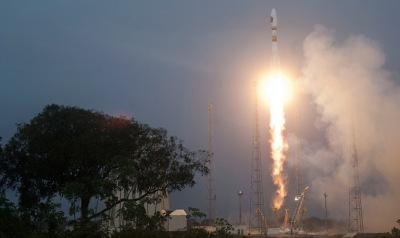
The first Soyuz launch vehicle to lift off from Arianespace's
facility in French Guiana successfully placed Europe’s first
two Galileo navigation satellites into orbit Friday. Lifting off
from the ELS launch site in the Spaceport’s northwestern
sector, Soyuz performed a 3-hour 49-minute flight to inject its two
Galileo In-Orbit Validation (IOV) spacecraft into a 23,222-km.
circular medium-Earth orbit, inclined 54.7 degrees.

With Friday's nominal launch, Soyuz
enters Arianespace’s growing launcher family –
providing a medium-lift vehicle operating at the Spaceport
alongside the heavy-lift Ariane 5, and to be joined in 2012 by the
lightweight Vega at French Guiana.
Soyuz has served as the launch vehicle for manned and unmanned
missions from its long-operating launch bases at Baikonur
Cosmodrome in Kazakhstan, and Russia’s Plesetsk Cosmodrome.
The maiden flight from its new “home” at the Spaceport
marked Soyuz’ 1,777th launch, and began at 0730:26 local time
in French Guiana – enabling the Galileo satellites’
injection into their proper orbital plane.
Arianespace Chairman & CEO Jean-Yves Le Gall noted that Soyuz
already has become a commercial success, with 14 firm payload
contracts booked for missions with this medium-lift vehicle from
the Spaceport – all signed prior to today’s inaugural
flight. He recognized the determined efforts of those who advanced
the Soyuz at French Guiana project from its first studies in the
late 1990s to a successful introduction today – stating that
the project’s key players are true space visionaries.
“Bravo Europe…bravo Russia…bravo
cooperation,” Le Gall added during comments made at the
Spaceport’s Jupiter mission control center.
Compared to other Soyuz launchers, the version used by
Arianespace at the Spaceport incorporates a new digital control
system that increases flight authority during the launcher’s
atmospheric ascent, and enables the use of an enlarged ST-type
payload fairing for greater flexibility in accommodating spacecraft
passengers.
It also is equipped with the Fregat upper stage, which is designed
as an autonomous orbital vehicle and has the capability to be
restarted up to 20 times in flight – enabling complex payload
deployment profiles to be performed. (Images courtesy
Arianespace)
More News
Airport Marking Aids Markings used on runway and taxiway surfaces to identify a specific runway, a runway threshold, a centerline, a hold line, etc. A runway should be marked in ac>[...]
"It is extremely difficult, if not impossible, for manned aircraft to see a drone while conducting crop-enhancing and other aerial applications at low altitudes and high speeds. We>[...]
Aero Linx: The Skyhawk Association The Skyhawk Association is a non-profit organization founded by former Skyhawk Pilots which is open to anyone with an affinity for the A-4 Skyhaw>[...]
“The T-54A benefits from an active Beechcraft King Air assembly line in Wichita, Kansas, where all required METS avionics and interior modifications are installed on the line>[...]
Aero Linx: Aerostar Owners Association The Association offers the Aerostar Owner a unique opportunity to tap an invaluable source of information concerning the care and feeding of >[...]



 ANN's Daily Aero-Term (04.28.24): Airport Marking Aids
 See All