Gone West: Astronaut Janice Voss | Aero-News Network
Aero-News Network
RSS icon RSS feed
podcast icon MP3 podcast
Subscribe Aero-News e-mail Newsletter Subscribe

** AIRBORNE 06.18.13 Aero-TV-- CLICK HERE! ** HD iPad-Friendly Version -- AIRBORNE 06.18.13 **

** AIRBORNE 06.14.13 Aero-TV-- CLICK HERE! ** HD iPad-Friendly Version -- AIRBORNE 06.14.13**

** AIRBORNE 04.01.13 SPECIAL EDITION of Aero-TV-- CLICK HERE! ** HD iPad-Friendly Version -- AIRBORNE 04.01.13 SPECIAL EDITION **

Wed, Feb 08, 2012

Gone West: Astronaut Janice Voss

Veteran Of Five Spaceflights Beginning In 1993

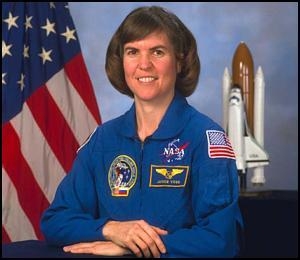
NASA astronaut Janice Voss passed away from cancer Monday night. One of only six women who have flown in space five times, Voss' career was highlighted by her work and dedication to scientific payloads and exploration.

"As the payload commander of two space shuttle missions, Janice was responsible for paving the way for experiments that we now perform on a daily basis on the International Space Station," said Peggy Whitson, chief of the Astronaut Office. "By improving the way scientists are able to analyze their data, and establishing the experimental methods and hardware necessary to perform these unique experiments, Janice and her crew ensured that our space station would be the site of discoveries that we haven't even imagined."

"During the last few years, Janice continued to lead our office's efforts to provide the best possible procedures to crews operating experiments on the station today," Whitson added. "Even more than Janice's professional contributions, we will miss her positive outlook on the world and her determination to make all things better."

Voss began her career with NASA in 1973 while a student at Purdue University. She returned to NASA in 1977 to work as an instructor, teaching entry guidance and navigation to space shuttle crews. After completing her doctorate in 1987, she worked within the aerospace industry until she was selected as an astronaut in 1990.

Voss’ first spaceflight mission was STS-57 in 1993, the first flight of the Spacehab module. She next flew on STS-63 in 1995, a mission to the Mir space station, and third flight of Spacehab. She also flew as a payload commander on STS-83 in 1997 with the Microgravity Science Laboratory, but the mission was cut short due to problems with one of the orbiter’s three fuel power generation units. Voss, the crew and MSL flew again as the STS-94 MSL-1 Spacelab mission, focused on materials and combustion science research in microgravity.

Her last mission was STS-99 in 2000, the Shuttle Radar Topography Mission, which mapped more than 47 million square miles of the Earth's land surface at unprecedented resolution levels. In total, Voss spent more than 49 days in space.

From 2004 to 2007, Voss served as the science director for the Kepler spacecraft at NASA's Ames Research Center. Voss most recently served as the payloads lead of the Astronaut Office's Station Branch.

FMI: www.jsc.nasa.gov/Bios/htmlbios/voss-jan.html

Advertisement

More News

Aero-TV: Garmin’s GNC-255 –- Back To Basics

Garmin's New Aviation VHF Radios Early this year, a new series of aviation VHF COM and NAV/COM radios, the GTR and GNC series, was announced by Garmin. As the replacement products >[...]

EADS And Siemens Enter Long-Term Research Partnership

Sign MoU With Diamond Aircraft On Electric Propulsion System EADS and Siemens are entering into a long-term research partnership to introduce new electric propulsion systems that c>[...]

ANN's Daily Aero-Term (06.19.13): Ceiling

The heights above the earth's surface of the lowest layer of clouds or obscuring phenomena that is reported as broken, overcast, or obscuration, and not classified as thin or parti>[...]

ANN's Daily Aero-Linx (06.19.13)

The Army Aviation Heritage Foundation The Army Aviation Heritage Foundation (AAHF) is a non-profit public educational foundation dedicated to presenting the Army Aviation story to >[...]

Aero-News: Quote Of The Day (06.19.13)

“The serial electric propulsion allows us to design airplanes with totally different characteristics than today. Vertical take-off and high-speed cruise can be realized in a >[...]

blog comments powered by Disqus


Advertisement

Advertisement

Podcasts

Advertisement

© 2007 - 2013 Web Development & Design by Pauli Systems, LC